Following the Star Constellation Catalogue
About This Catalogue
This catalogue presents all 88 modern constellations as recognised by the International Astronomical Union. Each entry includes a component diagram showing how the constellation would be constructed as a physical sculpture from side-glow fibre optic cable and glass crystals, suspended in the dry dock of the SS Great Britain.
12 constellations have been proposed for the initial installation, chosen for their navigational significance, mythological resonance, visual impact, and connection to the SS Great Britain's voyages between Liverpool and Melbourne. These are marked with a blue highlight and Proposed for Installation badge throughout this catalogue.
However, the client may choose from any of the 88 constellations presented here. Each has been designed and costed as a self-contained sculpture. The diagrams show the fibre routing, star crystal positions, and suspension points for each piece.
Star and edge counts reflect the physical components required: each star becomes a crystal on the fibre, and each edge represents a glowing segment of side-glow fibre optic cable connecting two stars.
- Total constellations available: 88
- Proposed for installation: 22
- Northern-hemisphere constellations: viewable from Bristol year-round
- Southern-hemisphere constellations: seen during the SS Great Britain's Australian voyages
Category Key
Each constellation is tagged with relevant categories:
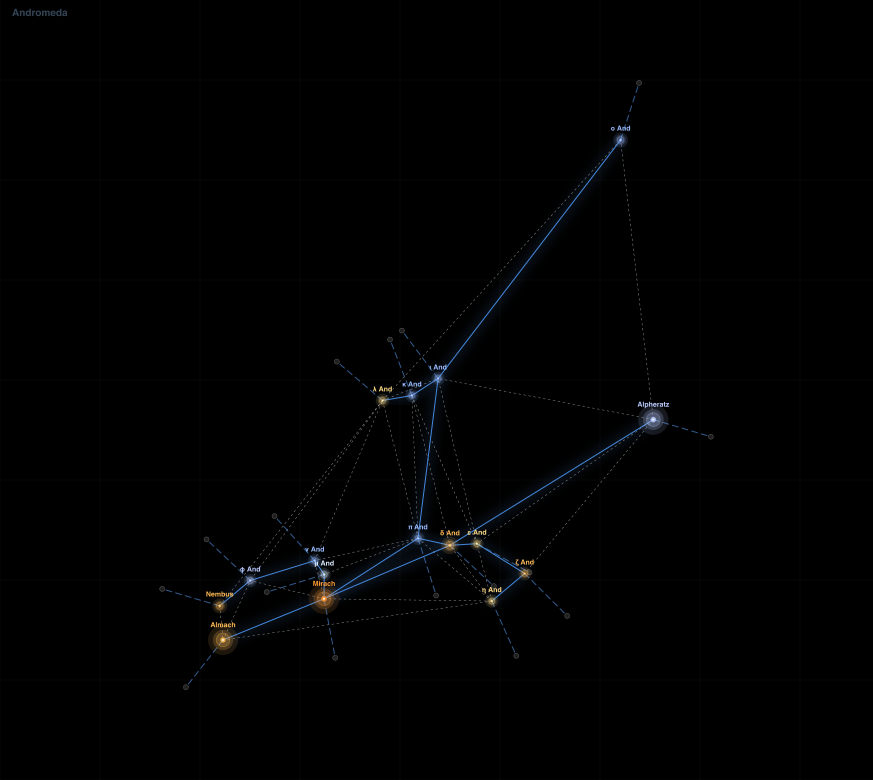
In Greek myth, Andromeda was the princess chained to a rock as sacrifice to the sea monster Cetus, rescued at the last moment by the hero Perseus. The constellation contains the Andromeda Galaxy (M31), the nearest major galaxy to our own, visible to the naked eye as a faint smudge on clear nights. Ptolemy catalogued Andromeda in the 2nd century, and she has remained one of the sky's most storied figures.
Greek myth: princess rescued by Perseus
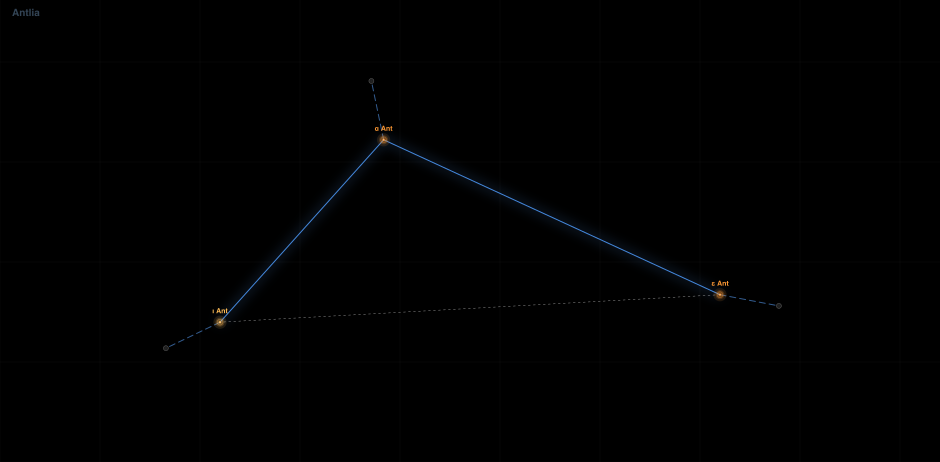
Antlia, the Air Pump, was introduced by the French astronomer Nicolas-Louis de Lacaille in the 1750s during his survey of southern skies from the Cape of Good Hope. It commemorates the vacuum pump invented by Denis Papin and Robert Boyle, celebrating the scientific instruments of the Enlightenment. A faint and modern constellation, it contains no stars brighter than fourth magnitude.
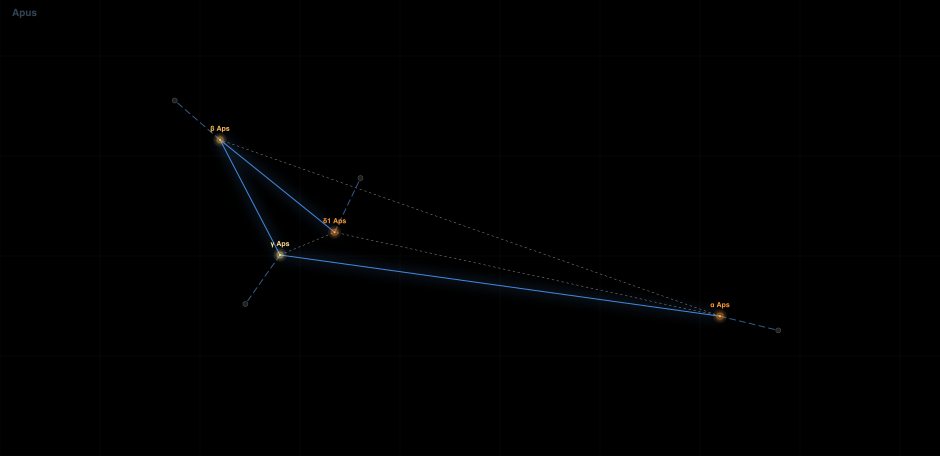
Apus, the Bird of Paradise, was created by the Dutch navigators Pieter Dirkszoon Keyser and Frederick de Houtman from observations made during their 1595 expedition to the East Indies. It represents the exotic birds of paradise brought back from the Malay Archipelago, whose skins arrived in Europe without feet, inspiring the myth that these birds never landed. Visible deep in the southern sky, it would have been seen by the crew of the SS Great Britain on her Australian voyages.
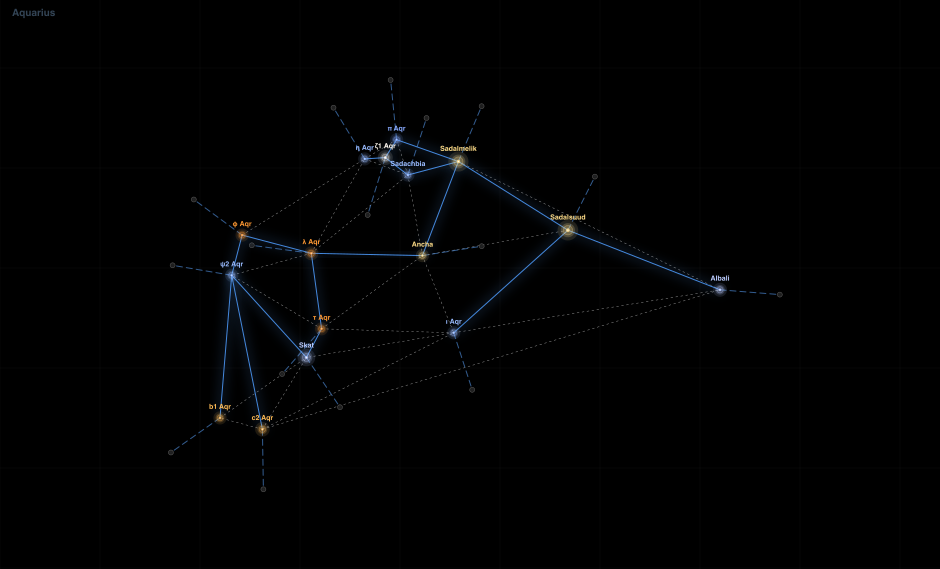
Aquarius, the Water Bearer, is one of the oldest recognised constellations, traced to Babylonian star catalogues where it represented the god Ea pouring the waters of life. In Greek tradition, it was associated with Ganymede, cupbearer to the gods on Mount Olympus. As a zodiacal constellation straddling the celestial equator, Aquarius was used by navigators to track the sun's annual journey.
Greek myth: Ganymede, cup-bearer to the gods
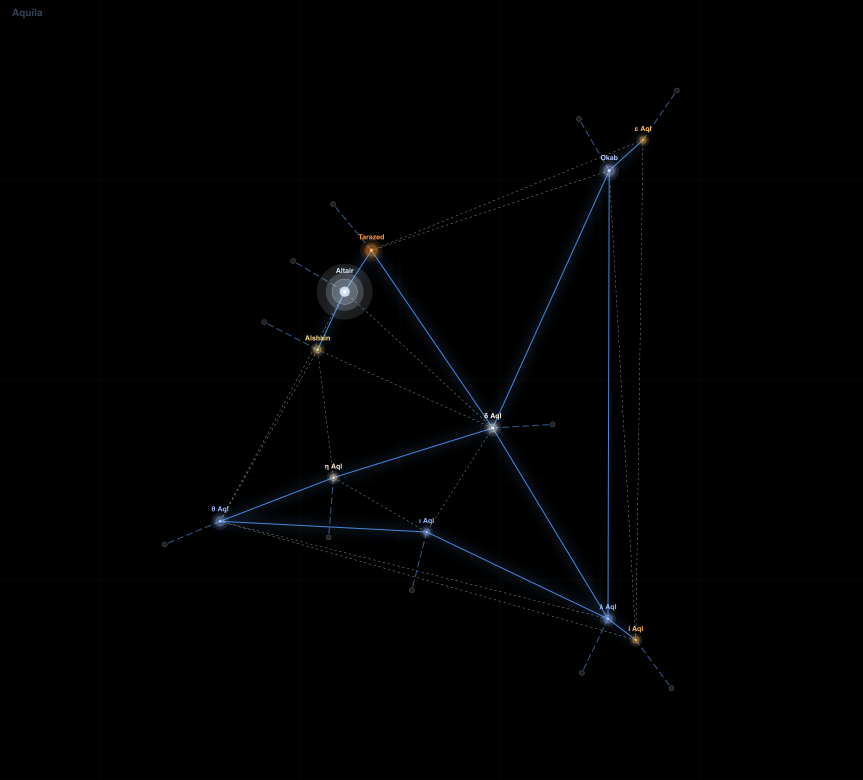
Aquila, the Eagle, was the bird that carried Zeus's thunderbolts in Greek mythology. Its brightest star, Altair, forms one vertex of the Summer Triangle and has been a key navigational star for millennia. At just 16.7 light-years distant, Altair is one of our nearest stellar neighbours, spinning so rapidly that it bulges at its equator. Sailors in both hemispheres have used Altair to determine latitude on summer nights.
Greek myth: Zeus's eagle, carried thunderbolts
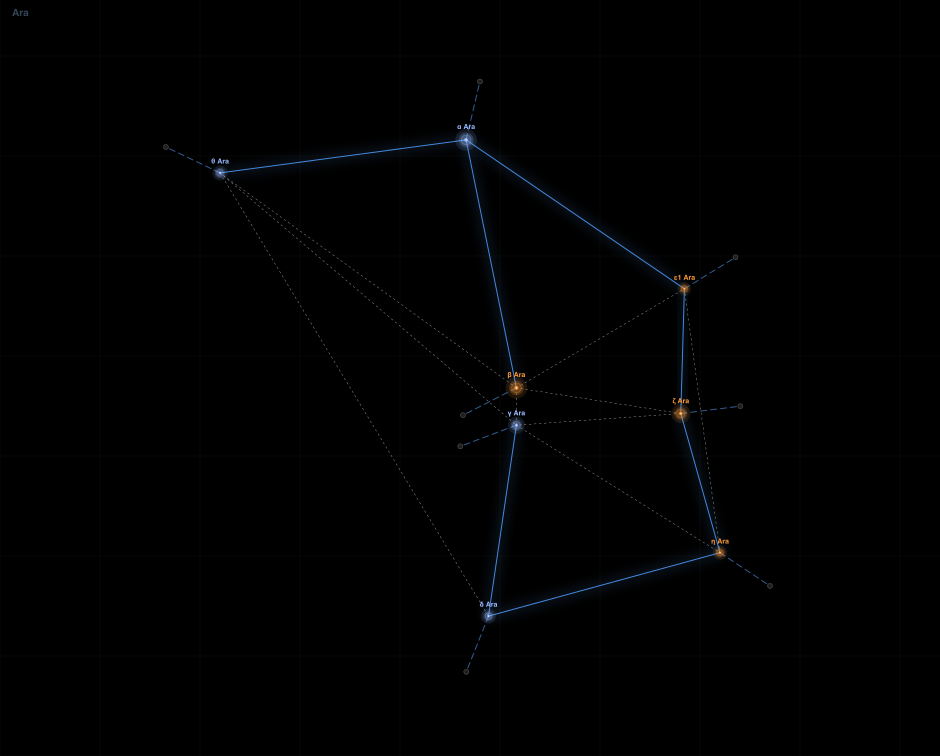
Ara, the Altar, was placed in the sky by the ancient Greeks as the altar upon which the Olympian gods swore their oath of allegiance before the war against the Titans. Ptolemy listed it among his original 48 constellations. Lying deep in the southern Milky Way, Ara would have been a striking sight from the deck of the SS Great Britain as she sailed through southern latitudes on her voyages to Australia.
Greek myth: the altar of the gods, where they swore alliance against the Titans
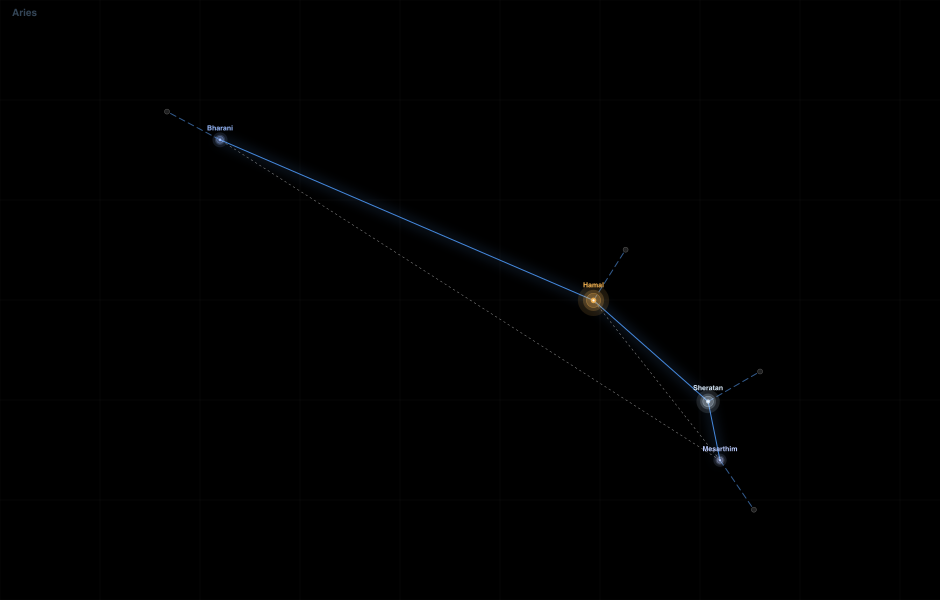
Aries, the Ram, represents the golden-fleeced ram of Greek legend whose fleece became the object of Jason's quest aboard the Argo. For over two thousand years, the First Point of Aries marked the vernal equinox, the starting point of the celestial coordinate system still used in navigation today. Although precession has shifted this point into Pisces, the name endures in maritime almanacs worldwide.
Greek myth: the golden ram whose fleece was sought by Jason
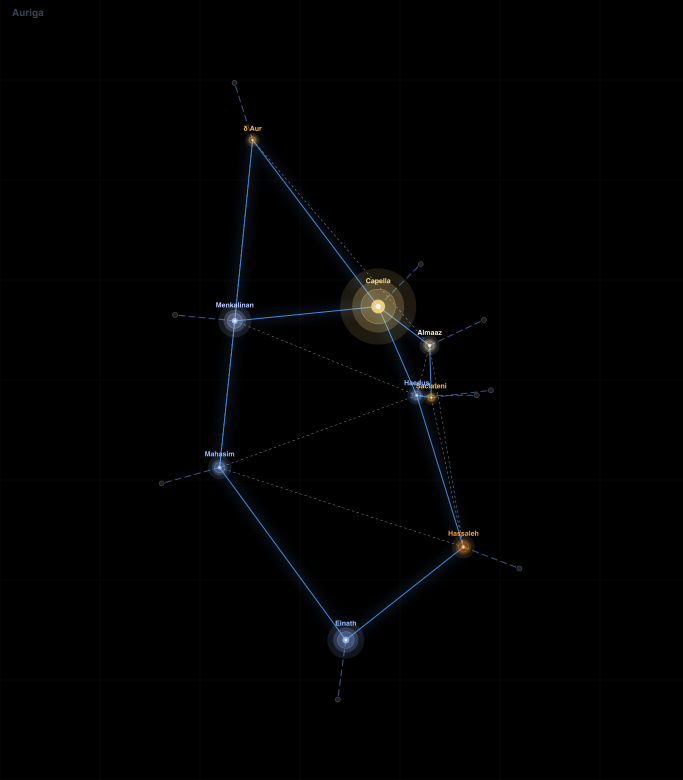
Auriga, the Charioteer, is dominated by Capella, the sixth-brightest star in the sky and one of the 58 navigational stars used in celestial navigation. Capella has guided mariners since antiquity; its name means 'little she-goat' in Latin, honouring the goat Amalthea who nursed the infant Zeus. The constellation's rich Milky Way fields contain several fine open clusters visible through binoculars.
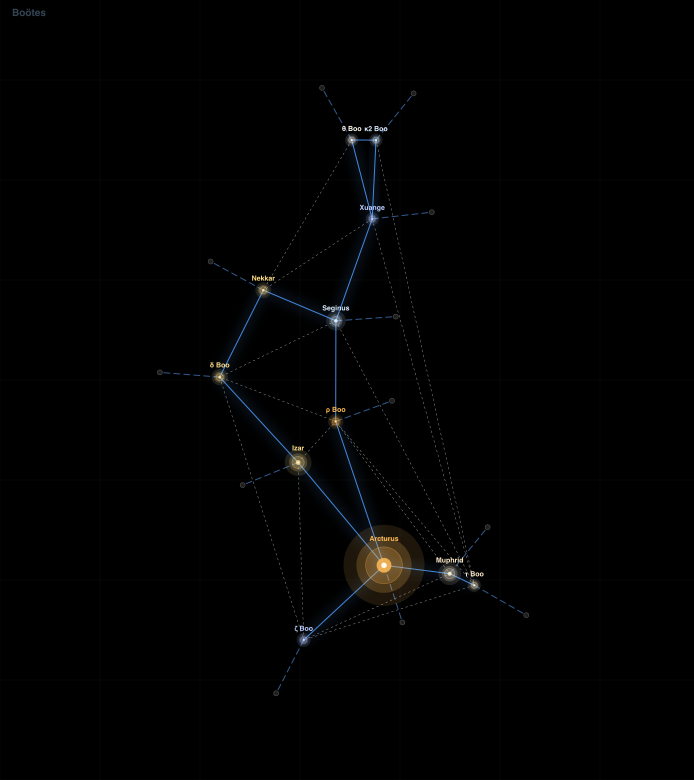
Boötes, the Herdsman, is anchored by Arcturus, a brilliant orange giant and the fourth-brightest star in the night sky. Polynesian navigators called Arcturus 'Hokule'a' — the Star of Joy — and used it to navigate to Hawai'i across thousands of miles of open Pacific. The star's name derives from the Greek for 'guardian of the bear', as Boötes appears to drive Ursa Major around the celestial pole.
Greek myth: the herdsman who drives the bear around the pole
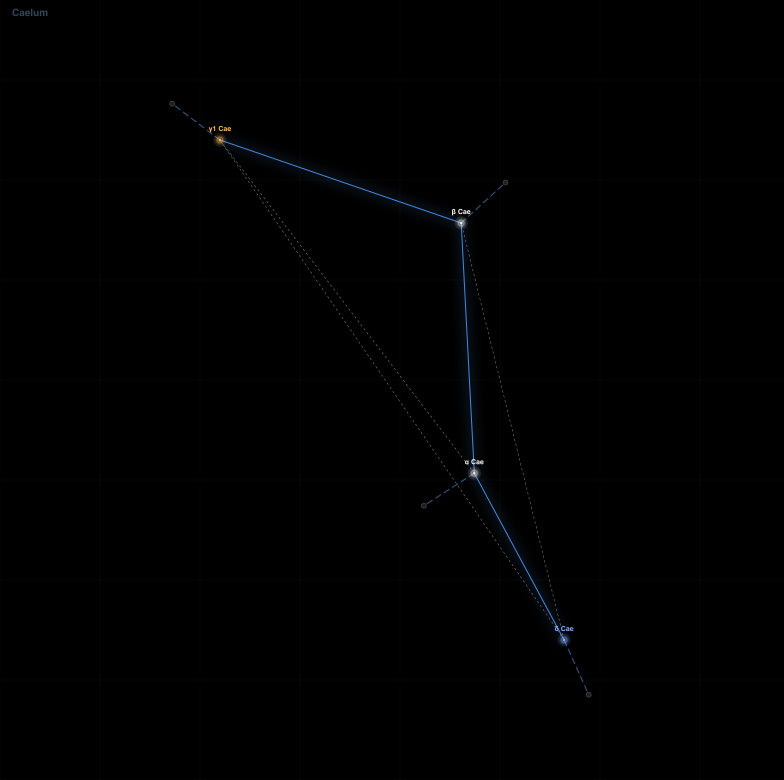
Caelum, the Engraving Tool (or Chisel), was introduced by Lacaille in the 1750s during his mapping of the southern heavens. One of the smallest and faintest constellations, it honours the tools of artists and craftsmen. Its stars are all below fifth magnitude, making it a challenge to identify even from dark southern-hemisphere sites.
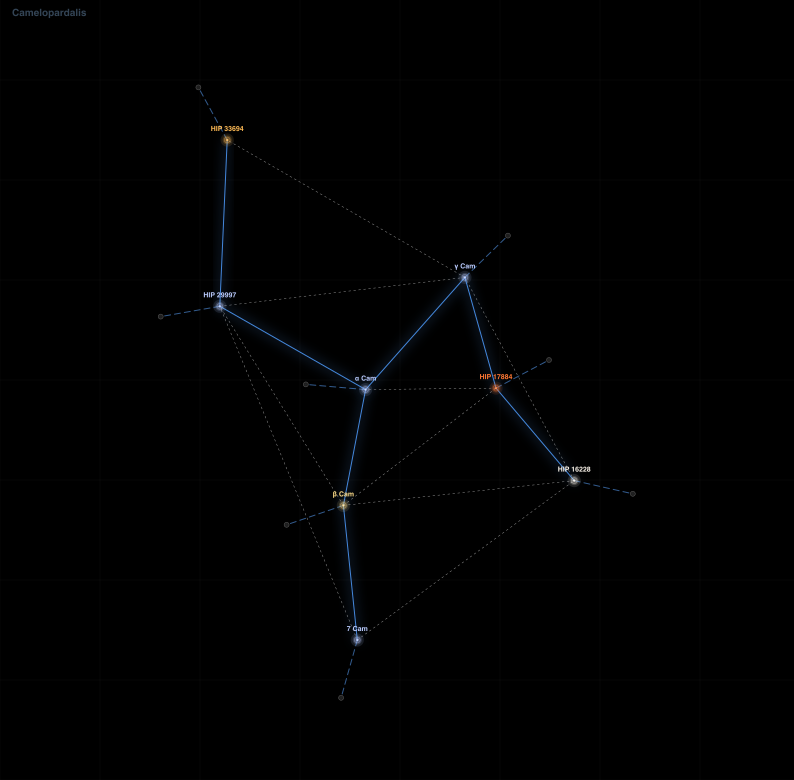
Camelopardalis, the Giraffe, was introduced by the Dutch astronomer Petrus Plancius in 1612. The name derives from the Greek for 'camel-leopard', reflecting the ancient belief that giraffes were a hybrid of the two animals. A circumpolar constellation from British latitudes, it fills a large but faint region between Ursa Major and Perseus, lacking bright stars but rich in distant galaxies.
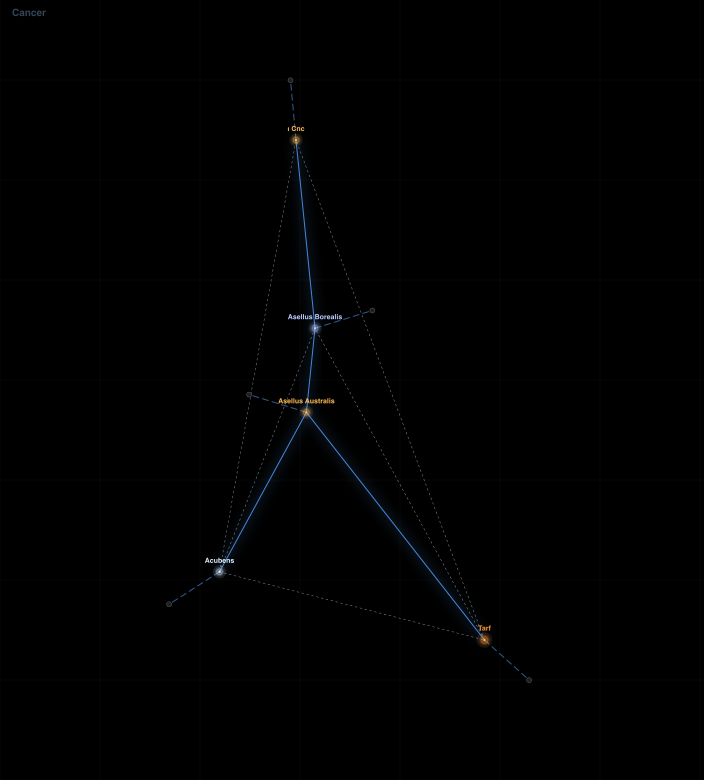
Cancer, the Crab, represents the creature sent by Hera to distract Heracles during his battle with the Lernaean Hydra. Though its stars are faint, Cancer hosts the Beehive Cluster (M44), one of the nearest open clusters to Earth, known since antiquity. The Tropic of Cancer takes its name from this constellation, as the sun once stood here at the June solstice.
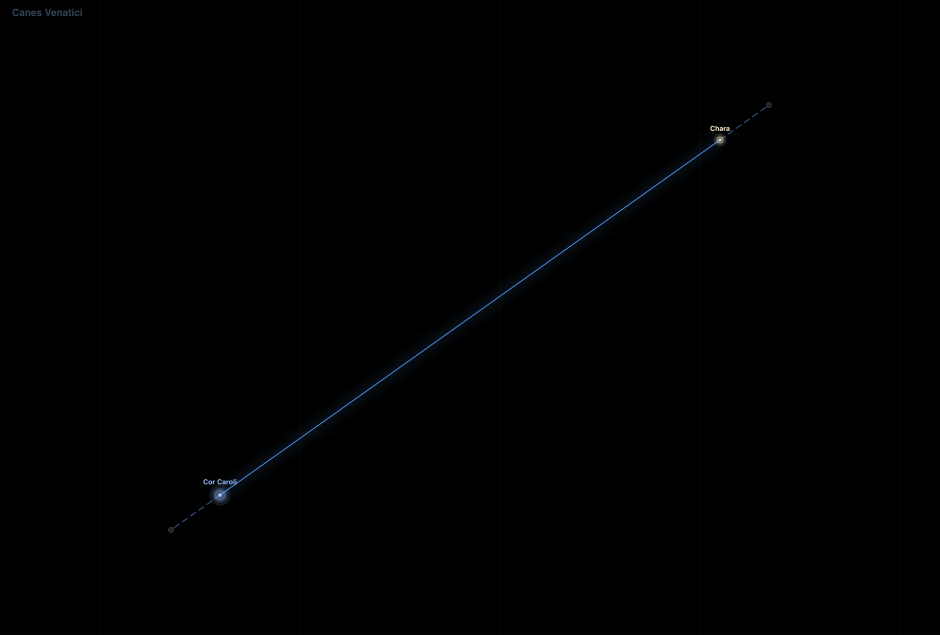
Canes Venatici, the Hunting Dogs, was delineated by Johannes Hevelius in 1687 from stars between Ursa Major and Boötes. Its brightest star, Cor Caroli, was named in honour of King Charles I of England. The constellation contains the magnificent Whirlpool Galaxy (M51), one of the first galaxies in which spiral structure was observed.
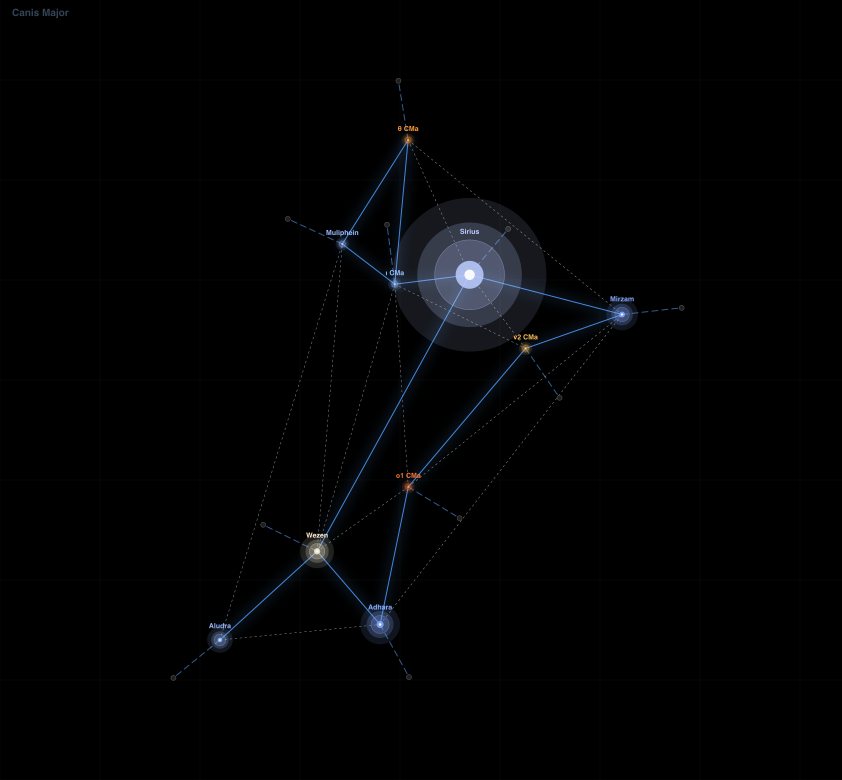
Canis Major, the Great Dog, contains Sirius, the brightest star in the night sky. Sirius has been central to navigation for millennia — it is one of the 58 navigational stars listed in the Nautical Almanac and its heliacal rising marked the start of the Egyptian calendar. On the SS Great Britain's winter departures from Liverpool, Sirius would have blazed low in the southern sky, a reliable bearing for the crew.
Greek myth: Orion's hunting dog; Sirius the 'Dog Star'
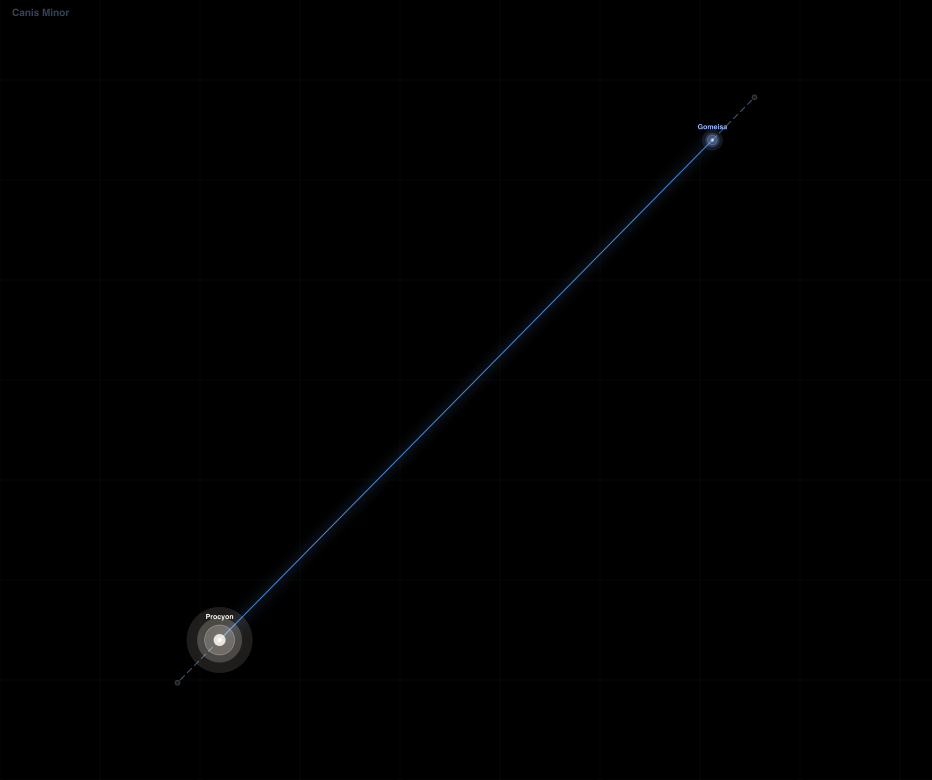
Canis Minor, the Lesser Dog, is marked by Procyon, the eighth-brightest star in the sky and one of the 58 navigational stars used in celestial fixes. Procyon means 'before the dog' in Greek, as it rises shortly before Sirius. At just 11.5 light-years from Earth, Procyon is one of our closest stellar neighbours and has been a dependable guide star for mariners crossing every ocean.
Greek myth: Orion's lesser hunting dog
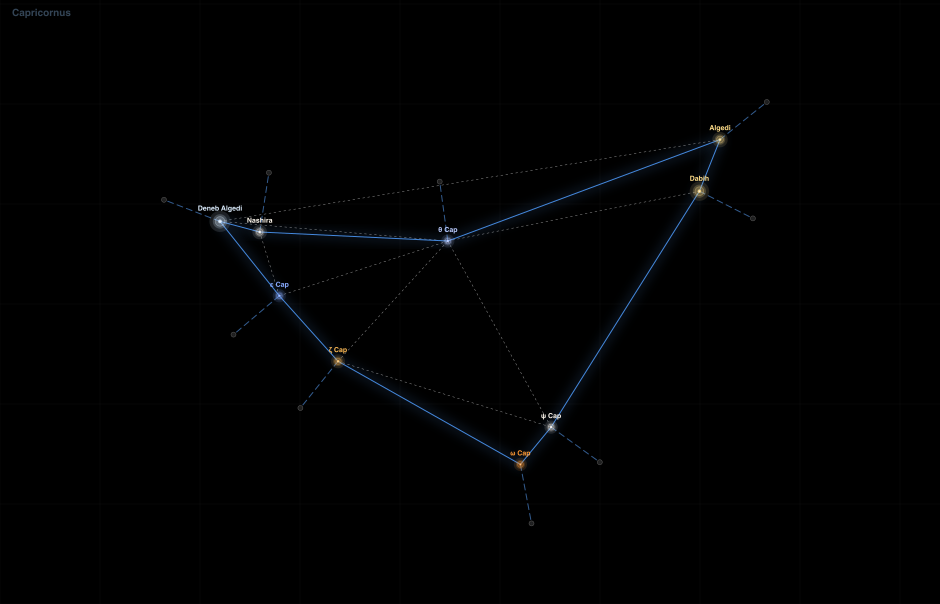
Capricornus, the Sea Goat, is one of the oldest constellations, depicted in Babylonian boundary stones as a creature with the front of a goat and the tail of a fish. The Tropic of Capricorn, which the SS Great Britain crossed on every voyage to Australia, takes its name from this constellation. In Greek myth it represents Pan, who leapt into the Nile in fright and transformed his lower half into a fish.
Greek myth: the sea-goat, linked to Pan
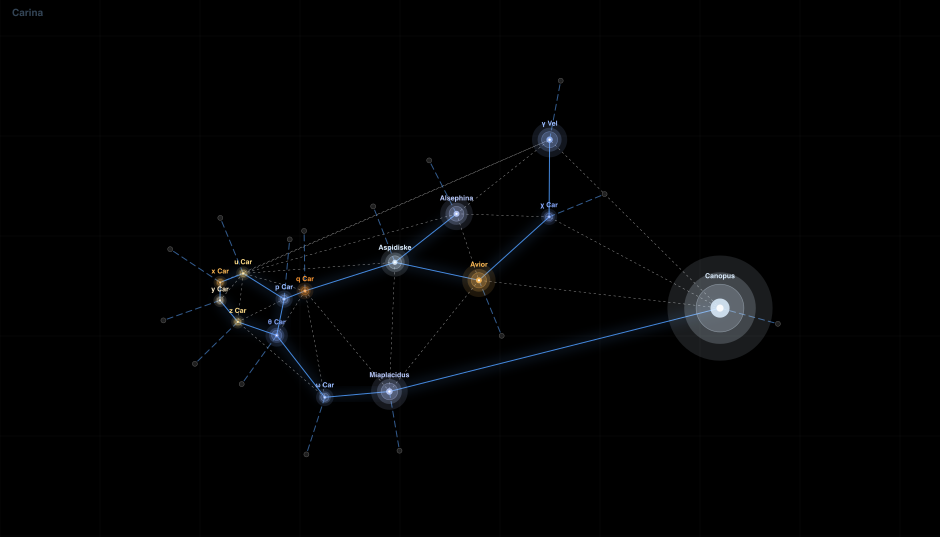
Carina, the Keel, was once part of the enormous ancient constellation Argo Navis, representing the ship of Jason and the Argonauts. Lacaille divided Argo into three parts in the 1750s, and Carina received the keel. Its brightest star, Canopus, is the second-brightest in the night sky and one of the most important navigational stars, used by every captain who sailed south of the equator — including those aboard the SS Great Britain.
Part of Argo Navis: the keel of Jason's ship — a ship within a ship
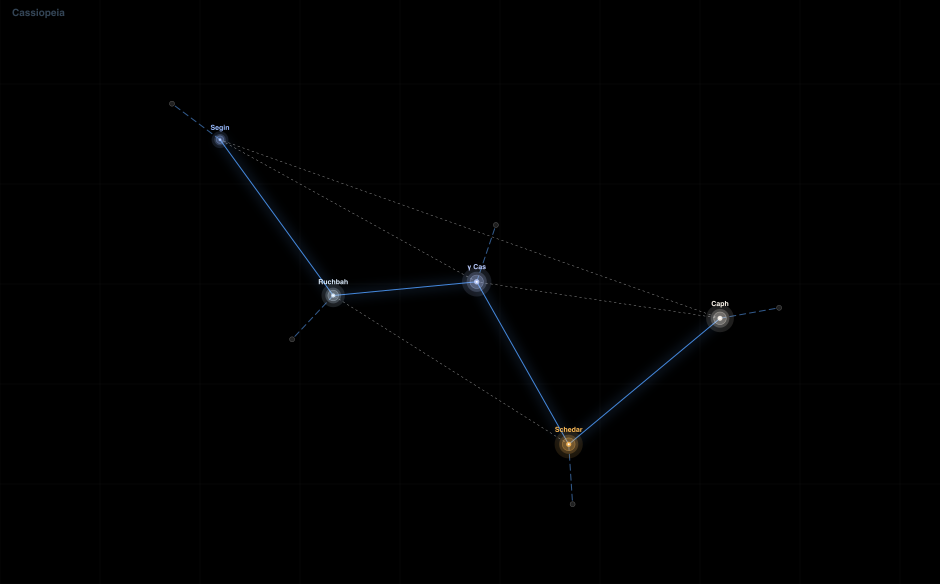
Cassiopeia, the vain queen of Ethiopian myth, is one of the most recognisable constellations, its five bright stars forming a distinctive W or M shape. Circumpolar from Bristol's latitude, Cassiopeia is visible every clear night of the year and has been used by navigators to locate true north via its relationship with Polaris. The supernova observed by Tycho Brahe in 1572 appeared within its borders.
Greek myth: the vain queen, mother of Andromeda
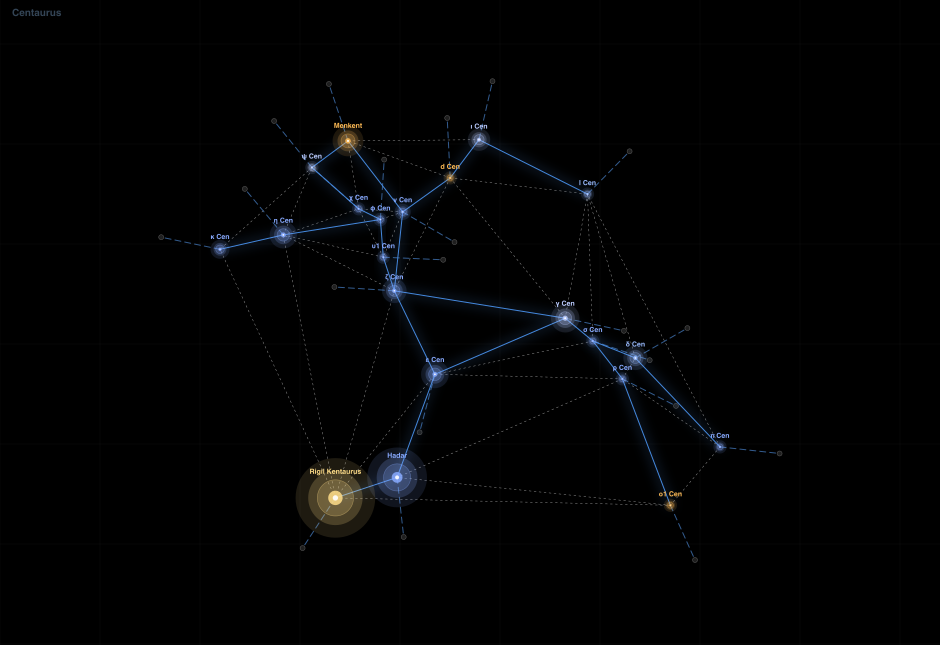
Centaurus, the Centaur, contains Alpha Centauri, the closest star system to our own sun at just 4.37 light-years. In mythology, it represents Chiron, the wise centaur who tutored Achilles and Asclepius. Centaurus would have been a magnificent sight from the SS Great Britain's deck in southern waters, with Alpha and Beta Centauri serving as pointer stars that lead directly to the Southern Cross.
Greek myth: Chiron, the wise centaur who taught heroes
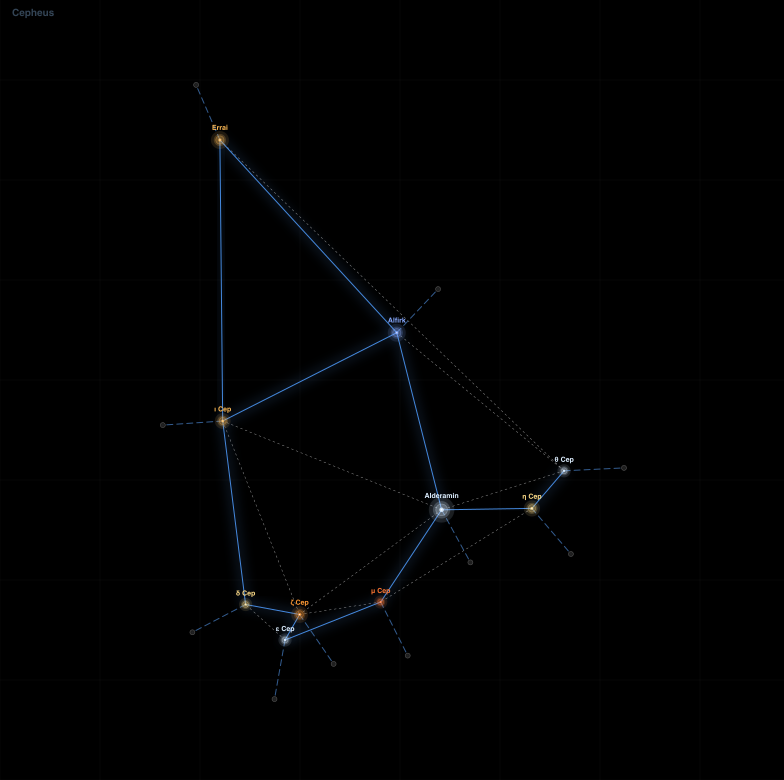
Cepheus, the King, was the husband of Cassiopeia and father of Andromeda in Greek mythology. A circumpolar constellation from northern latitudes, it contains Delta Cephei, the prototype of the Cepheid variable stars whose period-luminosity relationship became the key to measuring cosmic distances. Cepheus's stars have thus shaped our understanding of the universe's scale.
Greek myth: King of Aethiopia, husband of Cassiopeia
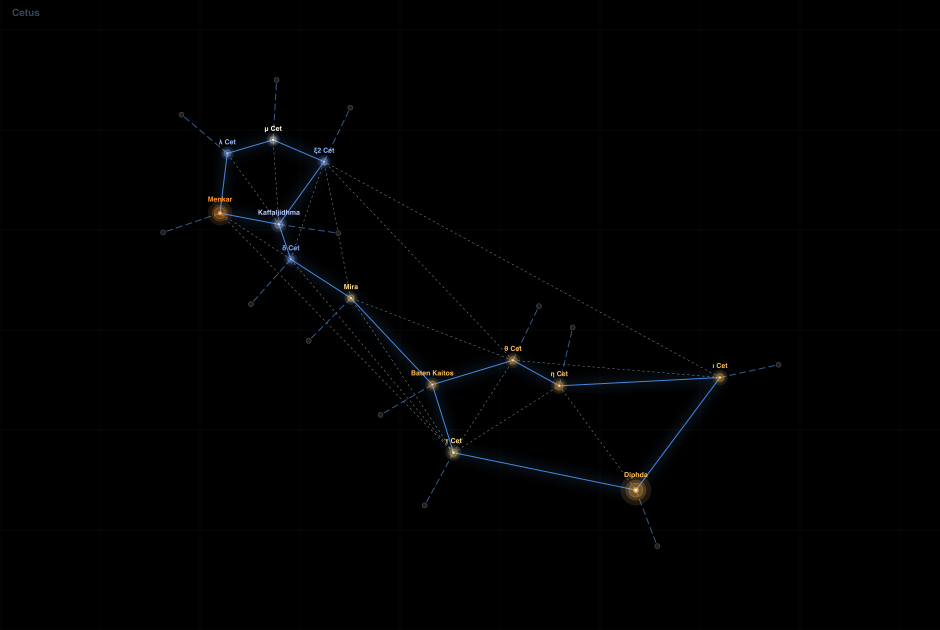
Cetus, the Sea Monster, represents the creature sent by Poseidon to ravage the coast of Ethiopia in the tale of Andromeda. Its most famous star, Mira ('the Wonderful'), was the first variable star recognised, its brightness changing dramatically over an 11-month cycle. Cetus sprawls across a large region of sky known to ancient astronomers as 'the Sea', alongside Aquarius, Pisces, and Eridanus.
Greek myth: the sea monster sent to devour Andromeda
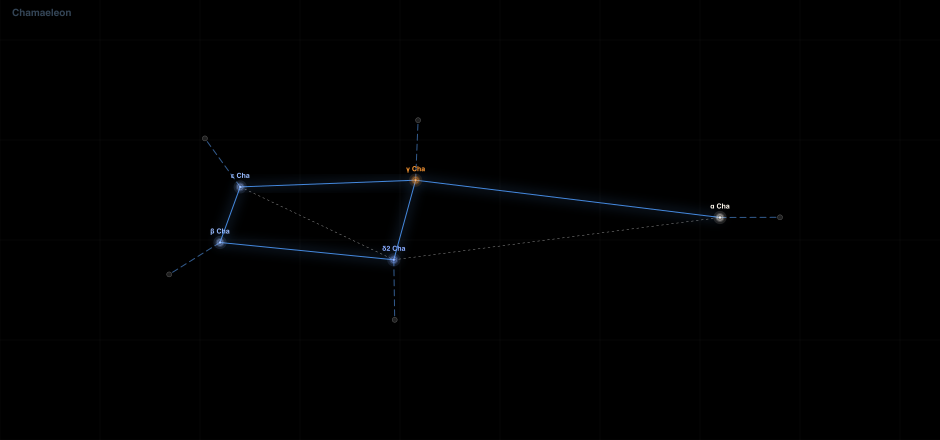
Chamaeleon was introduced by Keyser and de Houtman from their late-16th-century observations in the southern oceans. It represents the colour-changing lizard encountered by European explorers in tropical lands. A small and faint constellation near the south celestial pole, it lies in a region of sky that the SS Great Britain's passengers would have marvelled at during their months-long voyage to Melbourne.
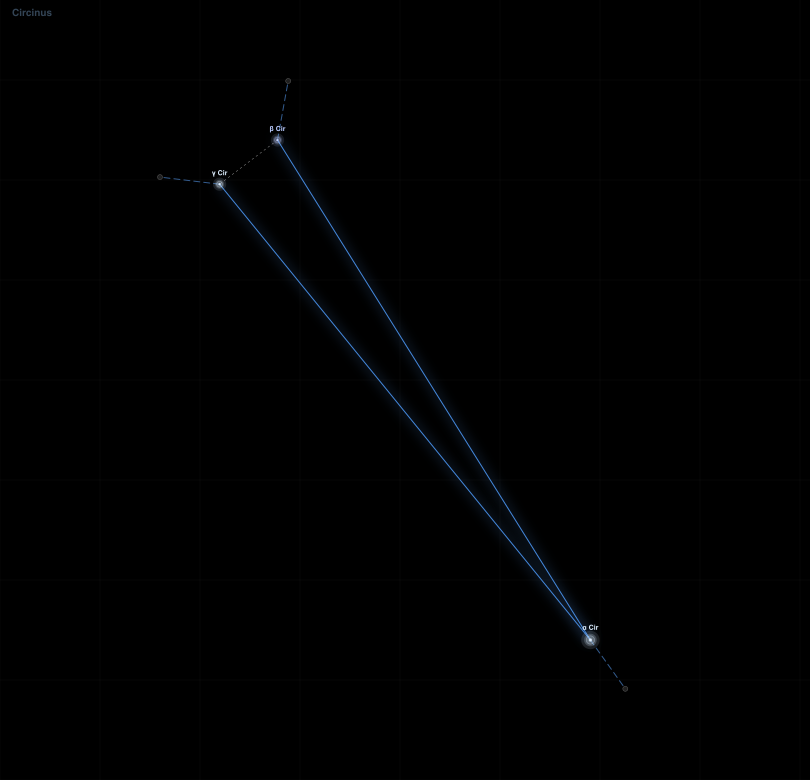
Circinus, the Compasses (the drafting instrument, not the navigational kind), was introduced by Lacaille in the 1750s. Appropriately for an installation at a maritime museum, it sits near Centaurus and Triangulum Australe deep in the southern Milky Way. Despite its small size, Circinus hosts an active Seyfert galaxy discovered in 1977.
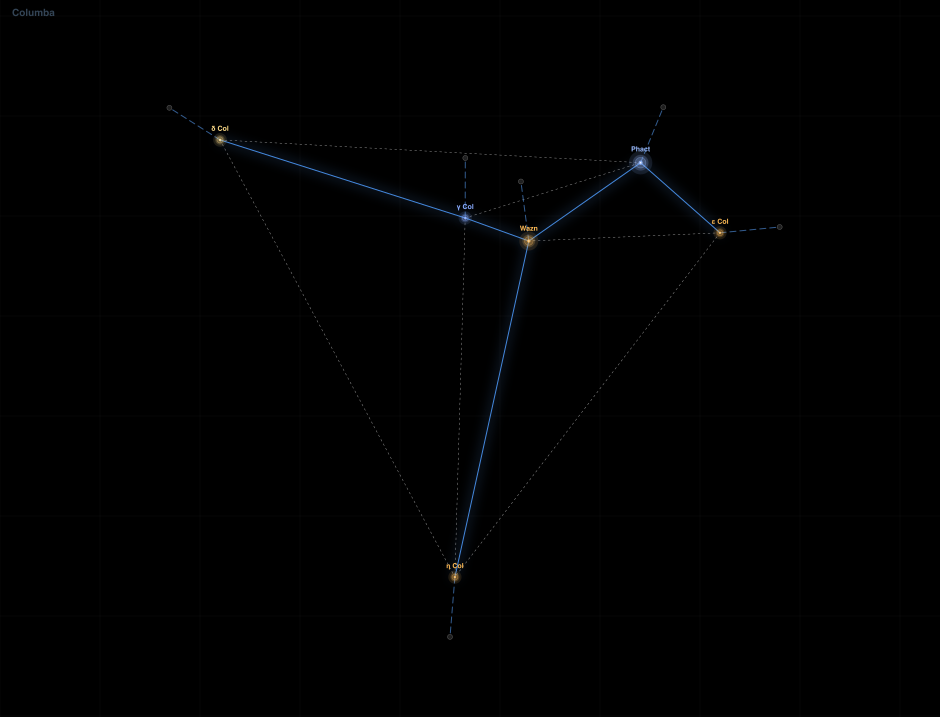
Columba, the Dove, was created by Petrus Plancius in the late 16th century, likely representing the dove sent by Noah from the Ark to find dry land. This maritime association makes it especially fitting for the SS Great Britain — a vessel that carried thousands of emigrants across the seas in search of new lives in Australia. Columba's brightest star, Phact, served as a southern navigational reference.
Biblical: Noah's dove, symbol of peace and safe harbour
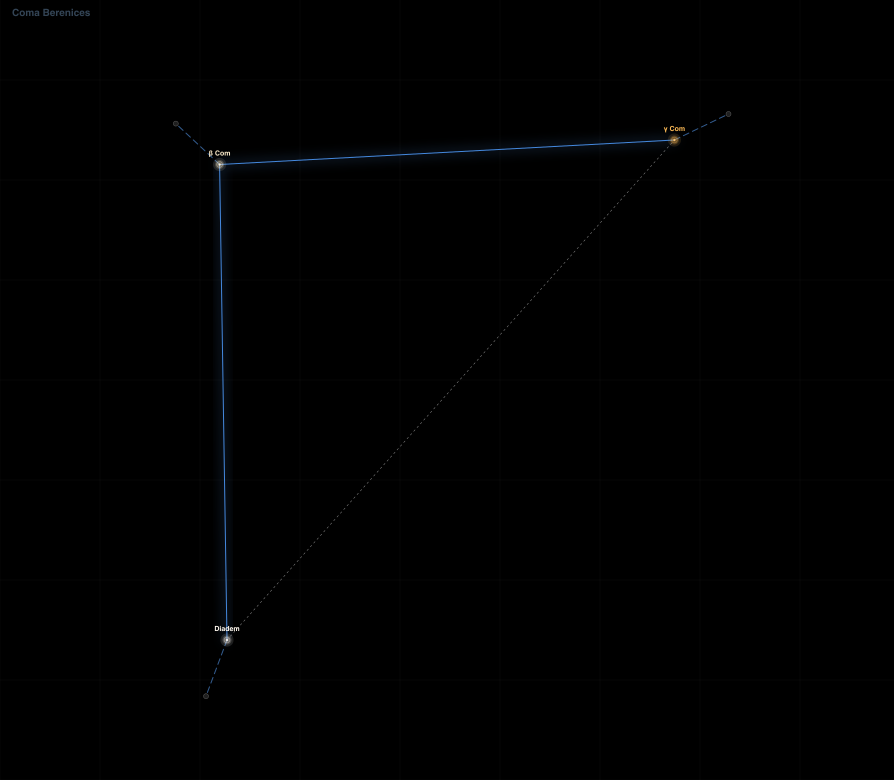
Coma Berenices, Berenice's Hair, commemorates the Egyptian queen Berenice II, who cut off her beautiful hair as an offering to Aphrodite for her husband's safe return from war. It is one of the few constellations named for a real historical person. The region is famous for the Coma Cluster of galaxies and the north galactic pole lies within its borders.
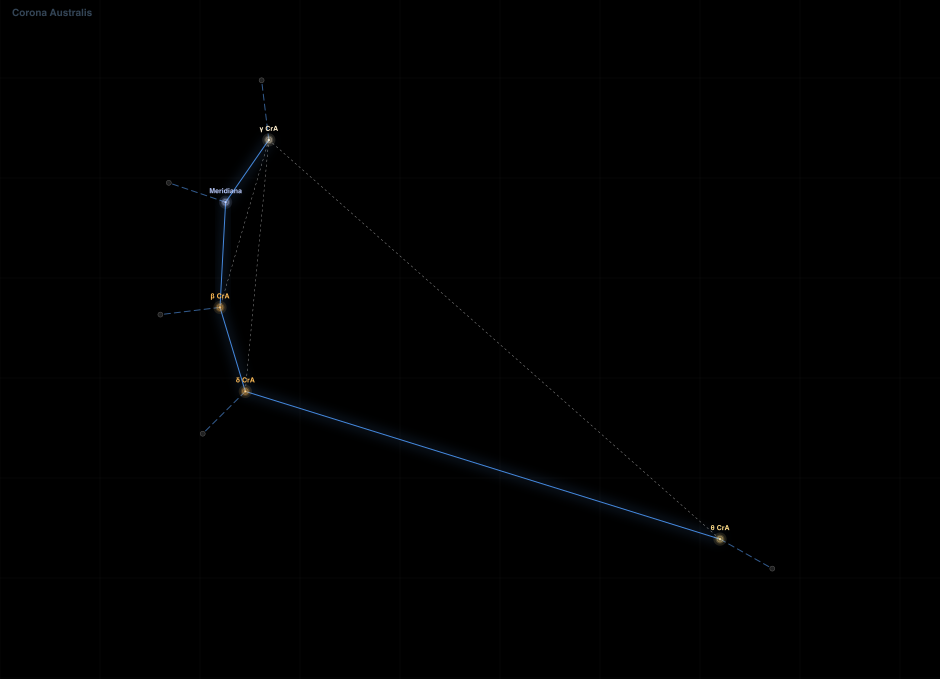
Corona Australis, the Southern Crown, was known to the ancient Greeks, who saw it as a wreath or laurel crown lying at the feet of Sagittarius. It is one of the smallest constellations but has been recognised since antiquity, listed by Ptolemy in his Almagest. Its arc of faint stars would have been visible from the SS Great Britain's deck during the Australian leg of her voyages.
Greek/Roman myth: a crown or wreath of the southern sky
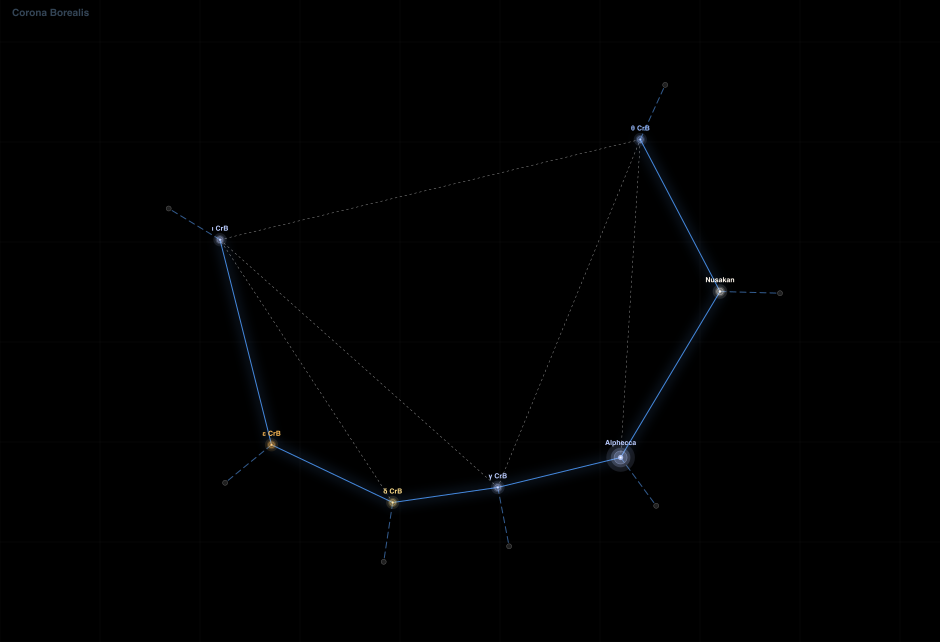
Corona Borealis, the Northern Crown, represents the jewelled crown given by Dionysus to Ariadne after she was abandoned by Theseus on the island of Naxos. Its distinctive semicircle of stars, anchored by Alphecca (Gemma), has been recognised by cultures worldwide. The constellation also contains T Coronae Borealis, a recurrent nova known as the 'Blaze Star'.
Greek myth: Ariadne's crown, gifted by Dionysus
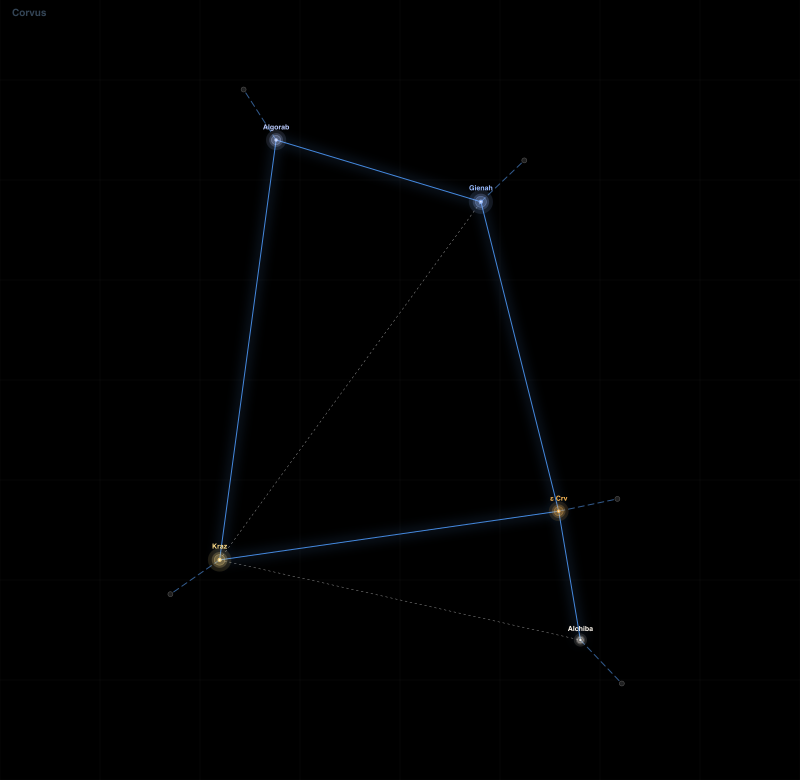
Corvus, the Crow, represents Apollo's sacred bird in Greek mythology, sent to fetch water but delayed while waiting for figs to ripen. Apollo punished the crow by placing it in the sky, forever near the cup (Crater) but unable to drink. Corvus forms a compact, recognisable quadrilateral of third-magnitude stars that has served as a useful reference pattern for navigators in tropical waters.
Greek myth: Apollo's crow, punished for bringing bad news
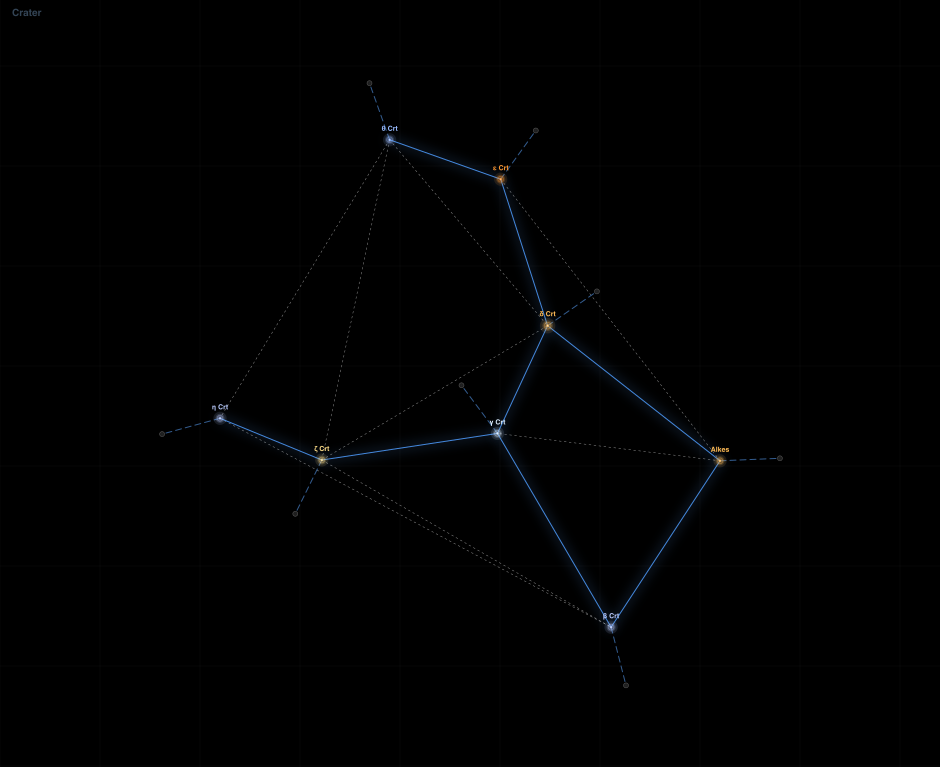
Crater, the Cup, represents the goblet of Apollo in Greek myth, placed in the sky alongside the faithless crow Corvus. Despite its ancient pedigree as one of Ptolemy's original 48 constellations, Crater contains no bright stars and requires clear, dark skies to appreciate. Its position between Leo and Hydra made it a useful seasonal marker for ancient Mediterranean sailors.
Greek myth: the cup of Apollo
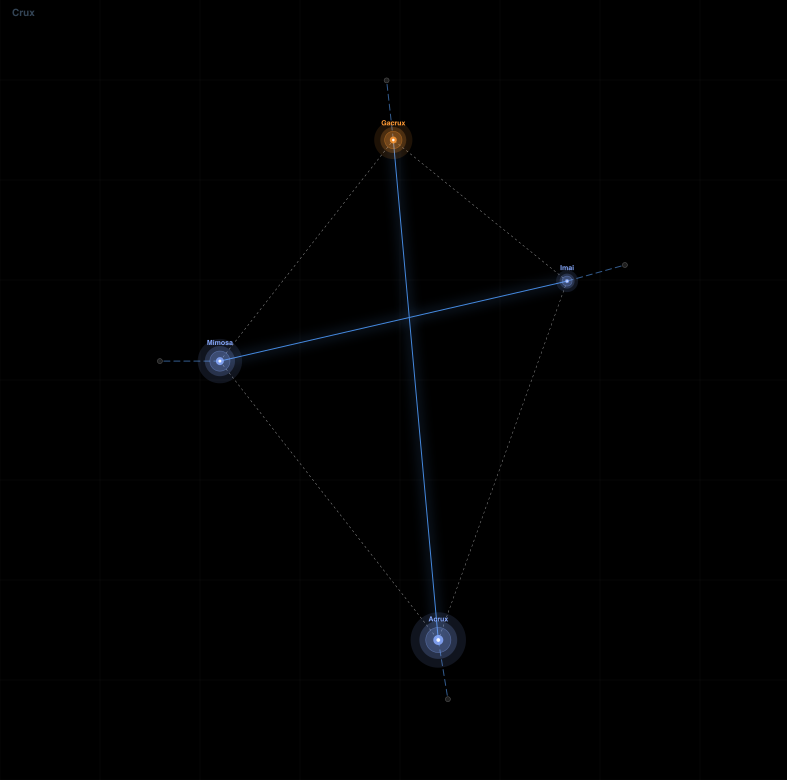
Crux, the Southern Cross, is the smallest of all 88 constellations yet one of the most celebrated. It has served as the primary means of finding south in the absence of a southern pole star, making it indispensable to every navigator who sailed below the equator. The crew of the SS Great Britain would have relied on Crux throughout their voyages to Australia, using its long axis to locate the south celestial pole. Its stars Acrux and Gacrux appear on the flags of Australia, New Zealand, and Brazil.
Christian symbolism: the Southern Cross; sacred to many cultures
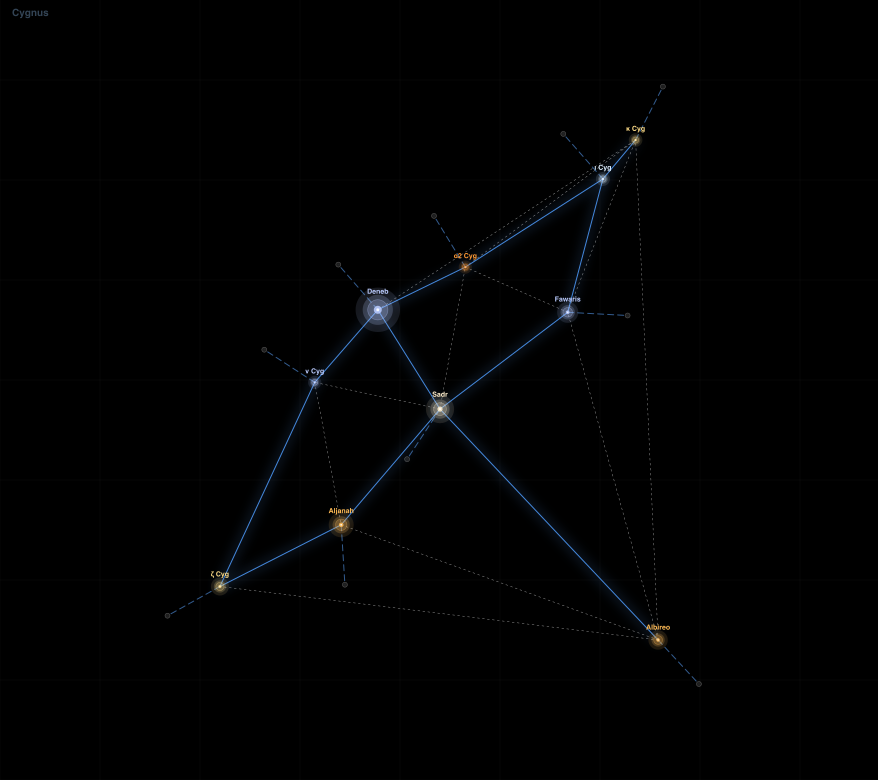
Cygnus, the Swan, flies along the luminous band of the Milky Way. In Greek myth it represents Zeus disguised as a swan, or alternatively Orpheus, placed among the stars beside his lyre. Its brightest star, Deneb, forms the Summer Triangle with Vega and Altair and is one of the most luminous stars visible to the naked eye. Deneb is also one of the 58 navigational stars used in celestial navigation.
Greek myth: Zeus disguised as a swan
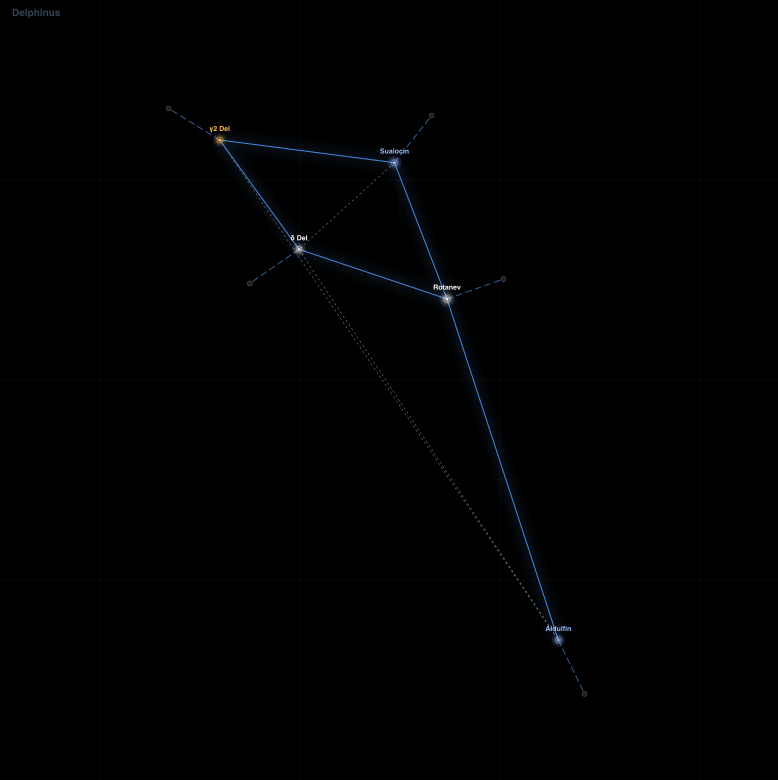
Delphinus, the Dolphin, is a small but charming constellation whose compact diamond of stars is easy to spot near the Summer Triangle. In mythology, it represents the dolphin sent by Poseidon to persuade the sea-nymph Amphitrite to become his bride, or the dolphin that rescued the poet Arion from drowning. Dolphins accompanying a ship were always considered a good omen by sailors.
Greek myth: the dolphin that rescued the poet Arion
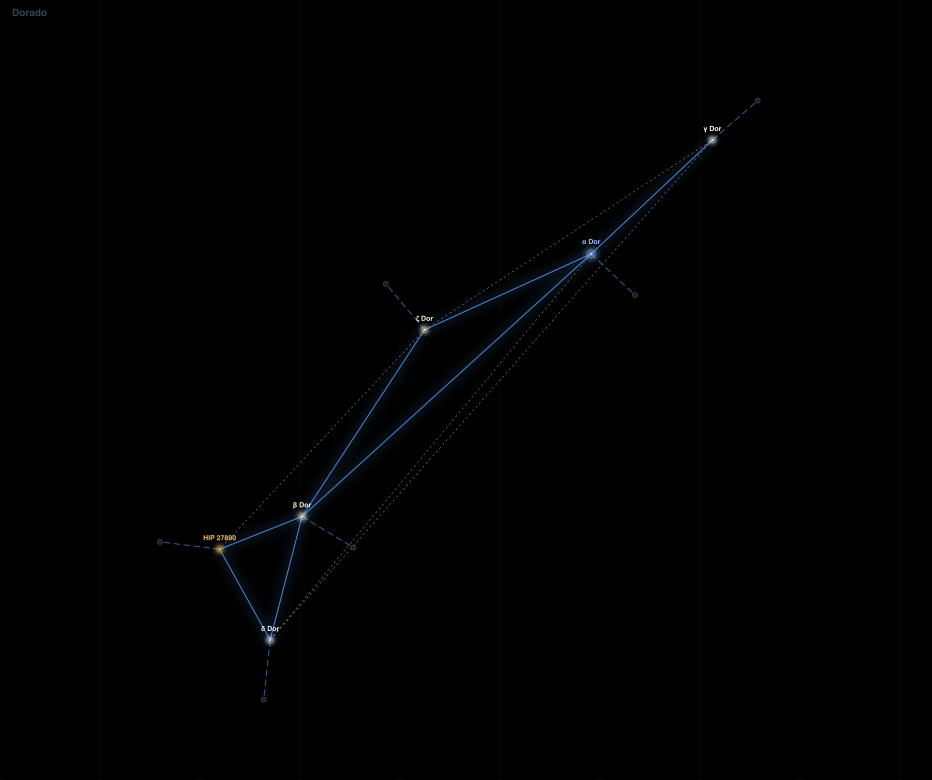
Dorado, the Swordfish (or Dolphinfish, Mahi-mahi), was introduced by Keyser and de Houtman and represents the colourful fish encountered in tropical seas. Its chief claim to fame is hosting the Large Magellanic Cloud, a satellite galaxy of the Milky Way visible to the naked eye from southern latitudes. Ferdinand Magellan's crew recorded it during their circumnavigation, giving it its name.
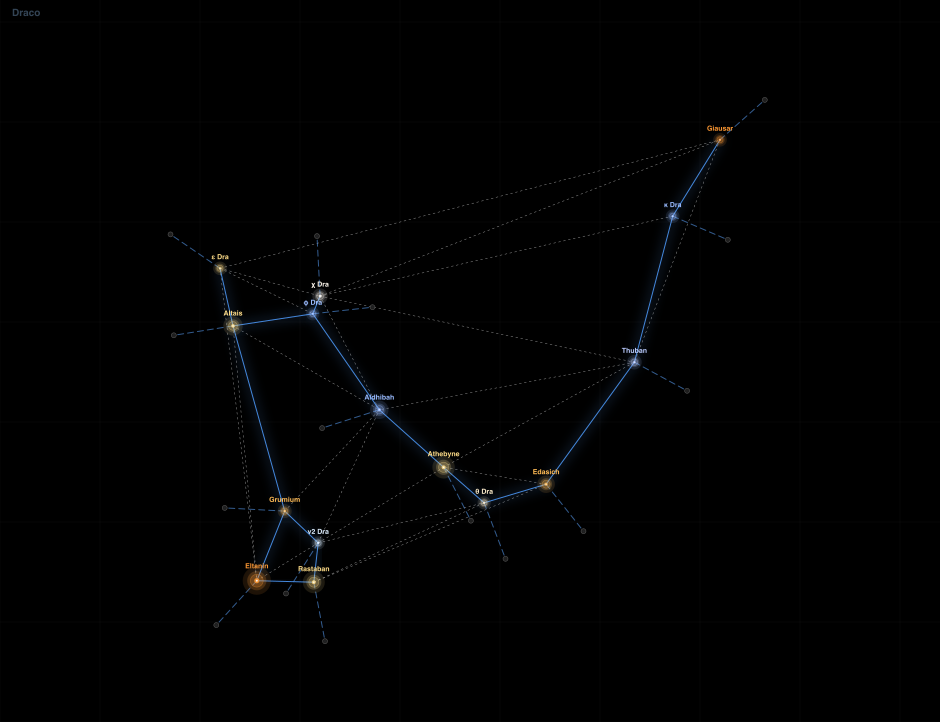
Draco, the Dragon, coils around the north celestial pole and is circumpolar from British latitudes. In Greek myth it represents Ladon, the hundred-headed dragon who guarded the golden apples of the Hesperides. Thuban, in Draco's tail, was the pole star when the Egyptian pyramids were built around 2700 BCE. The constellation's winding form spans more than 25 hours of right ascension.
Greek myth: the dragon Ladon, guardian of the golden apples
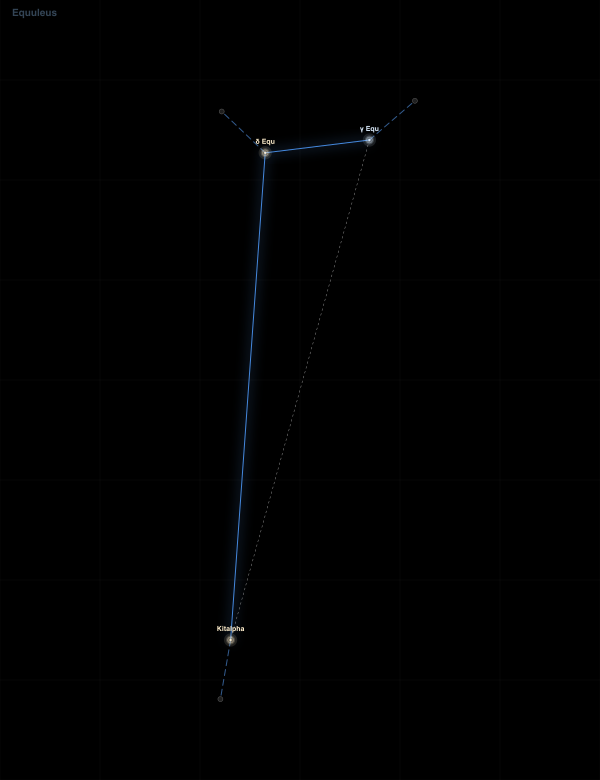
Equuleus, the Little Horse, is the second-smallest constellation in the sky. In mythology it may represent Celeris, the brother of Pegasus, or the foal given by Hermes to Castor. Despite its diminutive size, it was one of the 48 constellations listed by Ptolemy, suggesting it held significance for ancient stargazers. Its brightest star, Kitalpha, shines at only magnitude 3.9.
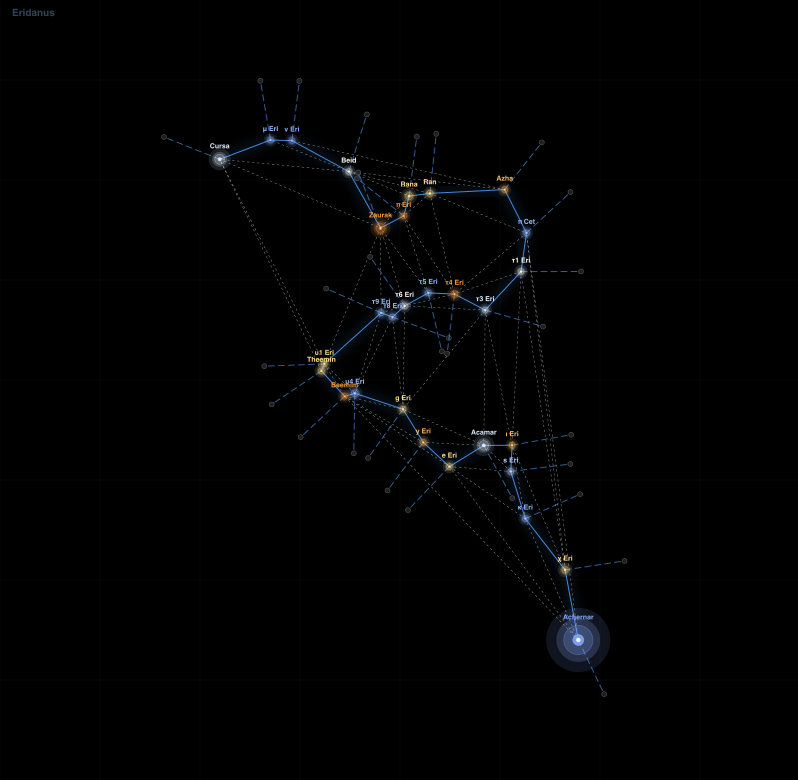
Eridanus, the River, is one of the longest constellations, winding from near Orion's foot deep into the southern sky. Ancient civilisations associated it with the Nile, the Euphrates, or the mythical river into which Phaethon fell after losing control of the sun's chariot. Its southern terminus, Achernar, is the ninth-brightest star and a key navigational star visible from the SS Great Britain as she approached Australian waters.
Greek myth: the celestial river, linked to Phaethon's fall
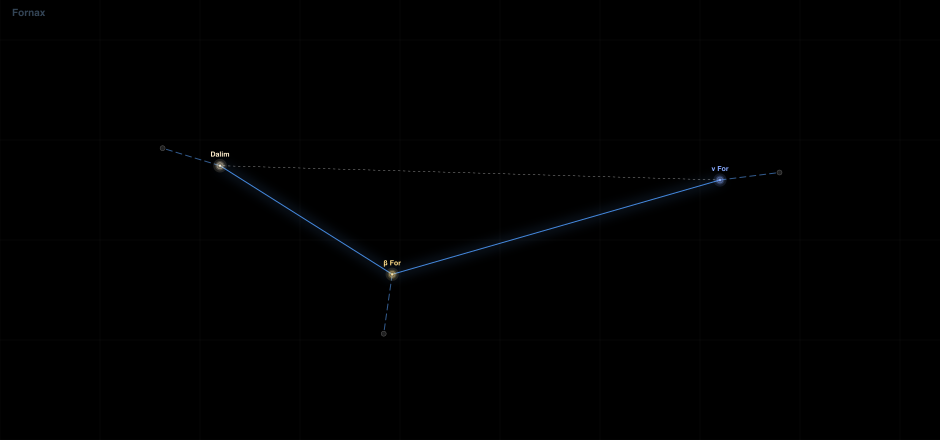
Fornax, the Furnace, was introduced by Lacaille in the 1750s, originally named for the chemical furnace used in scientific experiments. A faint constellation tucked into a bend of Eridanus, it hosts the Fornax Cluster of galaxies, one of the richest galaxy clusters in the southern sky. Its stars are inconspicuous but its deep-sky treasures are remarkable.
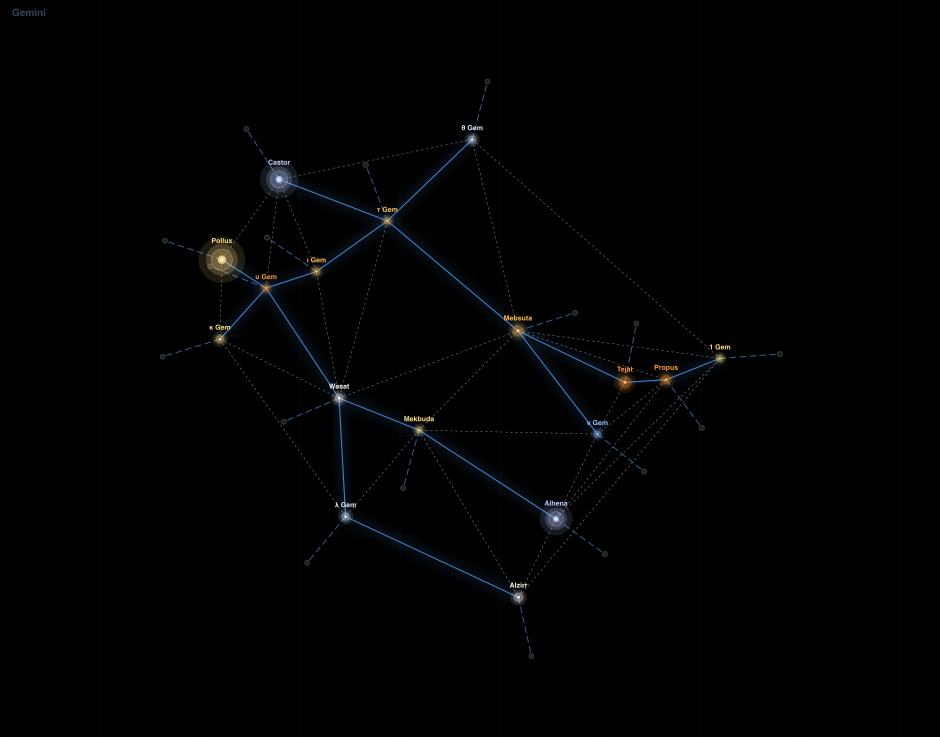
Gemini, the Twins, represents Castor and Pollux, the Dioscuri of Greek myth who were patron saints of sailors. Ancient mariners believed the twins protected ships at sea, and the electrical phenomenon of St Elmo's fire was attributed to their benevolence. Pollux is one of the 58 navigational stars, and the constellation's association with maritime safety makes it especially resonant for the SS Great Britain.
Greek myth: Castor and Pollux, patron saints of sailors
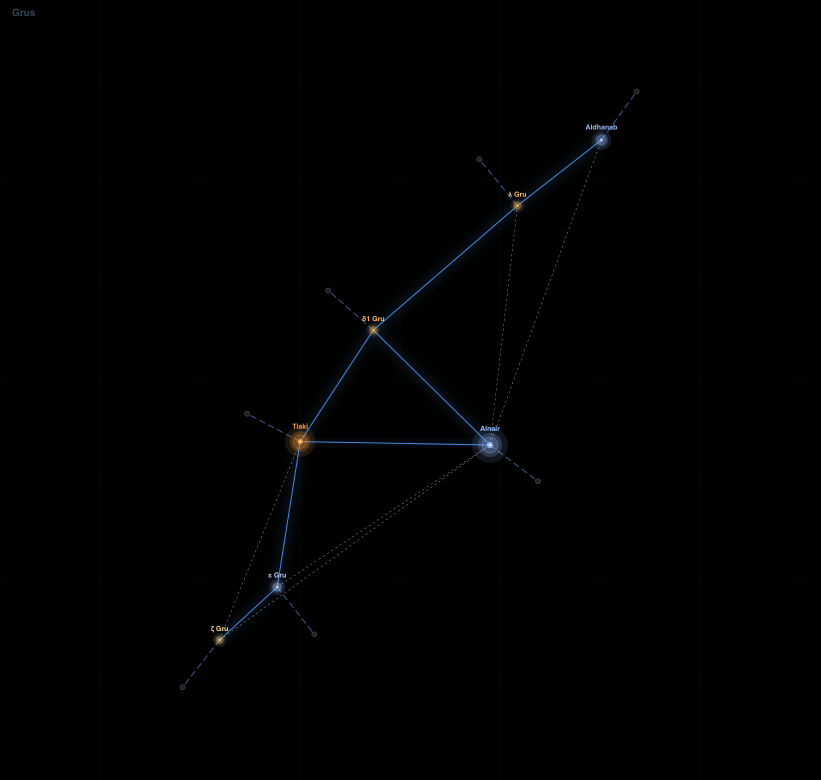
Grus, the Crane, was introduced by Keyser and de Houtman from their southern voyages. Its brightest star, Alnair, is one of the 58 navigational stars and served as a key reference for ships sailing in southern waters. The graceful crane was considered a symbol of vigilance in many cultures, standing watch through the night much like the sailors who observed it.
The crane: symbol of vigilance in many cultures
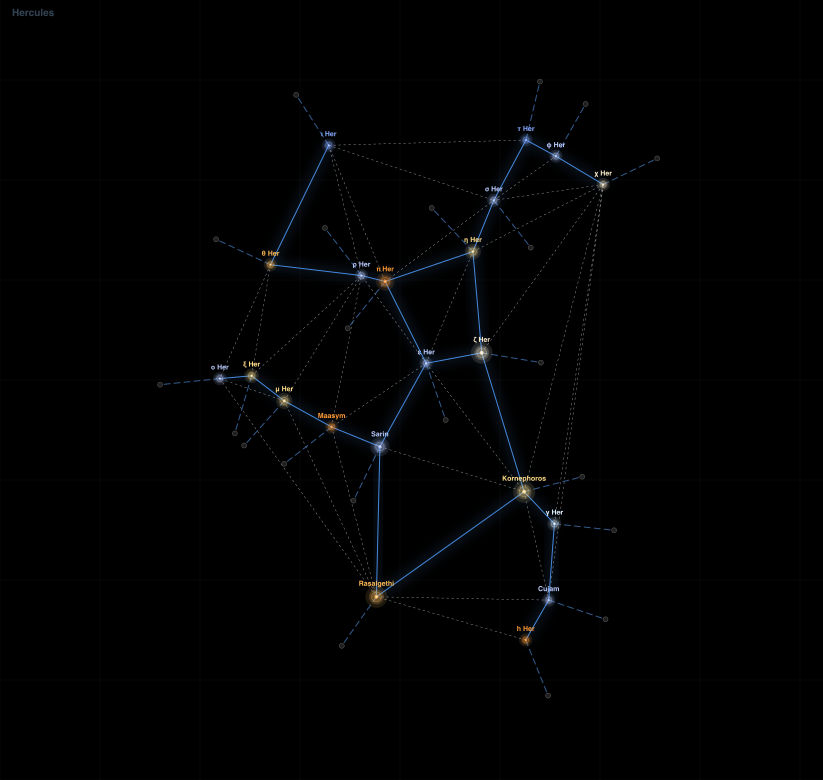
Hercules, the great hero of Greek mythology, is the fifth-largest constellation but contains no first-magnitude stars, lending it a quiet grandeur. Its central asterism, the Keystone, hosts M13, the Great Globular Cluster — a swarm of several hundred thousand ancient stars. In 1974, the Arecibo message was beamed towards M13, humanity's first deliberate radio transmission to the stars.
Greek/Roman myth: the divine hero and his twelve labours
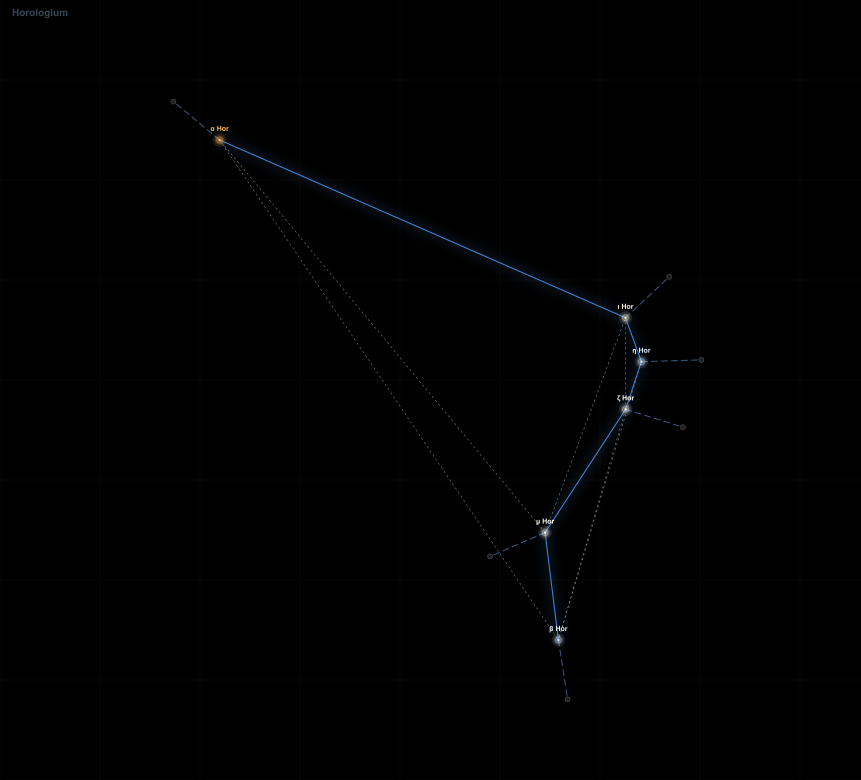
Horologium, the Pendulum Clock, was introduced by Lacaille to honour Christiaan Huygens' invention of the pendulum clock in 1656 — a breakthrough that revolutionised timekeeping and, by extension, marine navigation. Accurate clocks were essential for determining longitude at sea, a problem that consumed the maritime world for centuries. The constellation thus celebrates a pivotal moment in navigational history.
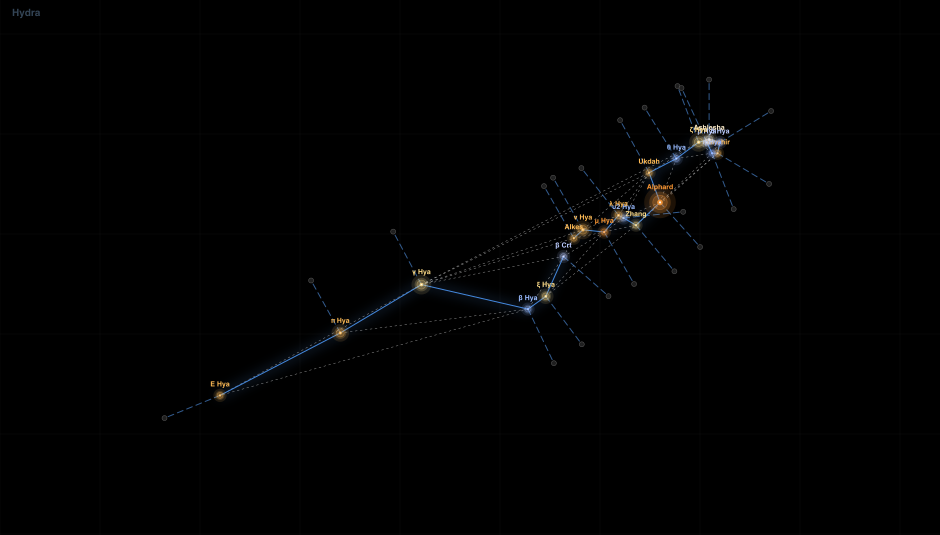
Hydra, the Water Snake, is the largest of all 88 constellations, stretching across more than a quarter of the sky. In Greek myth it represents the multi-headed serpent slain by Heracles as the second of his twelve labours. Its only bright star, Alphard ('the Solitary One'), was used by Arab navigators as a reference point in an otherwise empty region of sky.
Greek myth: the many-headed water serpent slain by Hercules
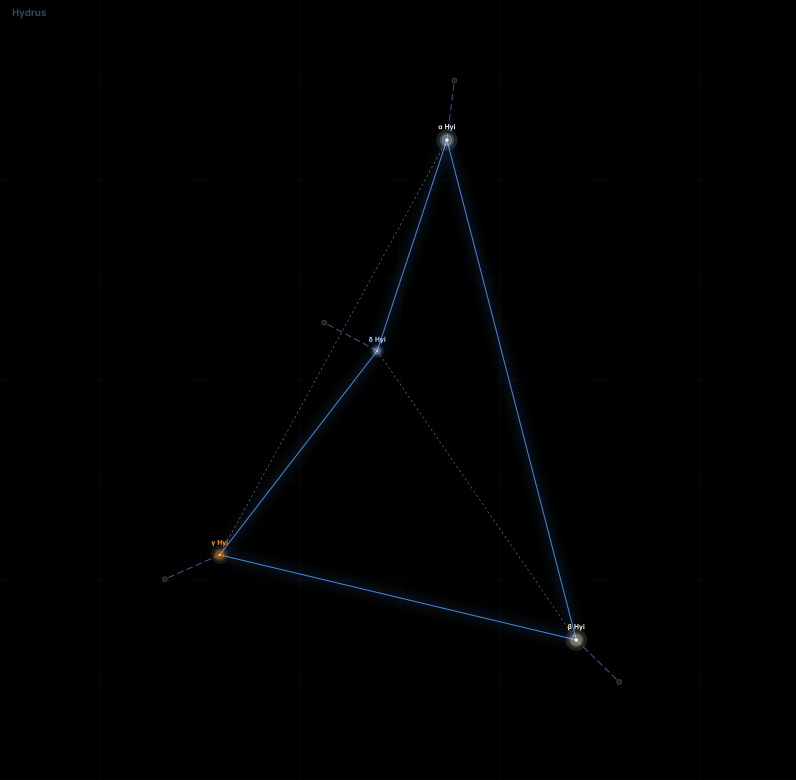
Hydrus, the Lesser Water Snake, was introduced by Keyser and de Houtman and lies between the Large and Small Magellanic Clouds. Not to be confused with the ancient constellation Hydra, Hydrus is a purely southern creation. Its stars would have been visible to the SS Great Britain's crew during the long southern-ocean crossing between the Cape of Good Hope and Melbourne.
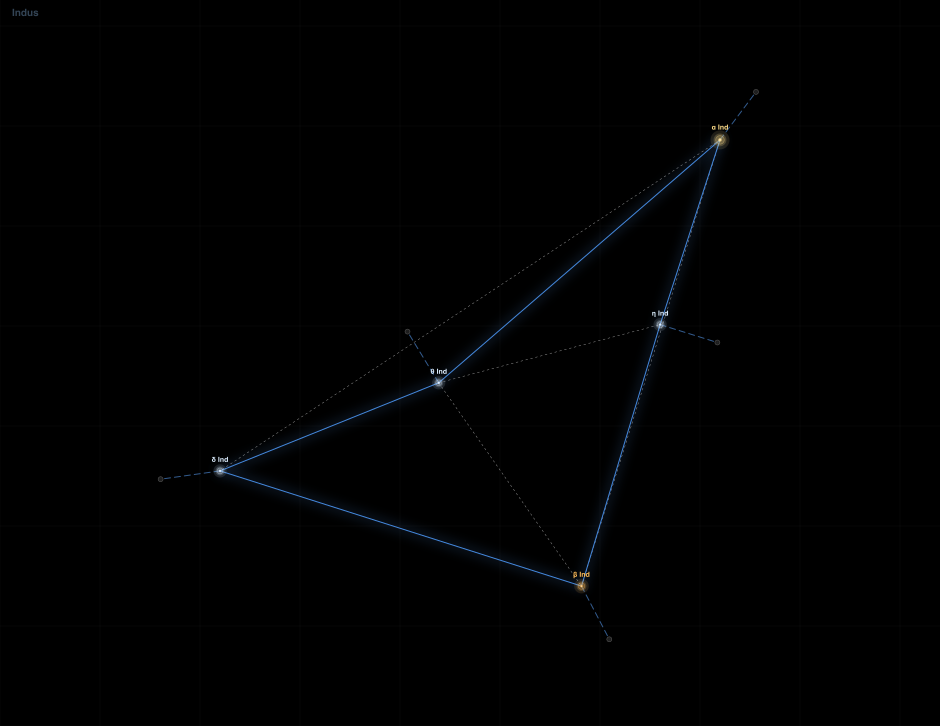
Indus, the Indian, was introduced by Keyser and de Houtman and represents an indigenous person of the lands encountered during early European voyages to the East Indies. The constellation contains Epsilon Indi, one of the nearest sun-like stars at just 11.8 light-years from Earth. It lies in a relatively sparse region of the southern sky between Grus and Pavo.
Represents indigenous peoples encountered by European explorers
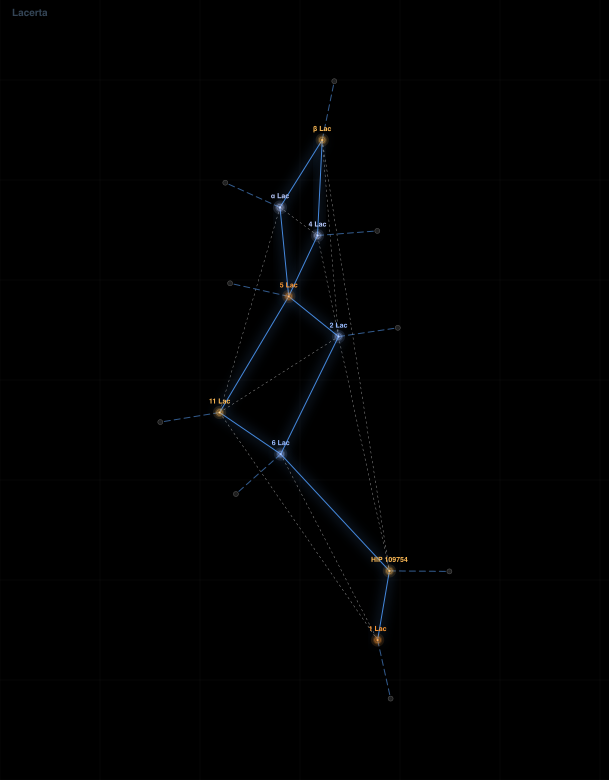
Lacerta, the Lizard, was introduced by Johannes Hevelius in 1687 to fill a gap between Cygnus and Andromeda. Despite its obscurity, it hosts BL Lacertae, the prototype of an entire class of active galactic nuclei known as blazars. Its zigzag line of faint stars requires dark skies to trace, making it a challenge even for experienced observers.
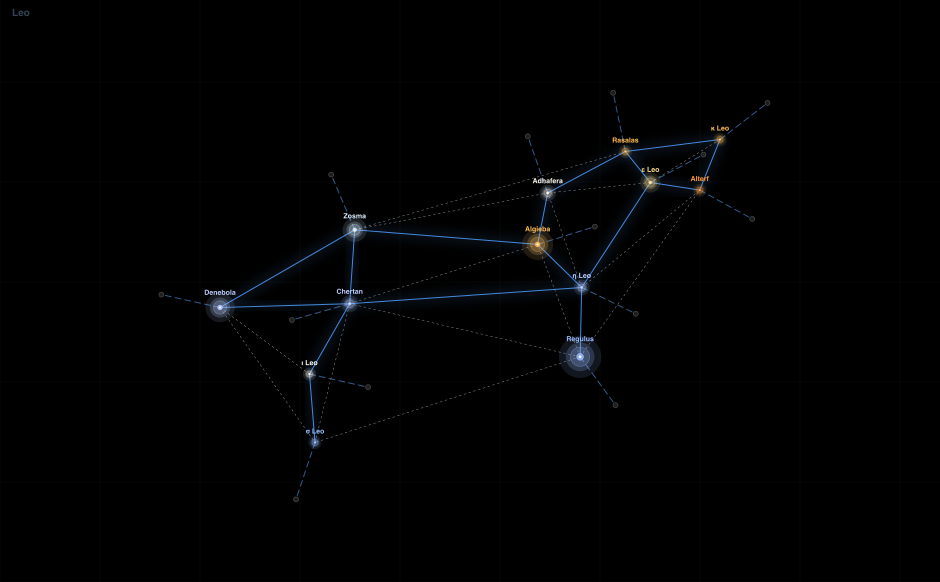
Leo, the Lion, is one of the most ancient and recognisable constellations, its sickle-shaped asterism representing the Nemean Lion slain by Heracles. Its brightest star, Regulus, meaning 'little king', is one of the 58 navigational stars and lies almost exactly on the ecliptic. Leo has been associated with royalty and power across cultures from Mesopotamia to medieval Europe.
Greek myth: the Nemean Lion slain by Hercules
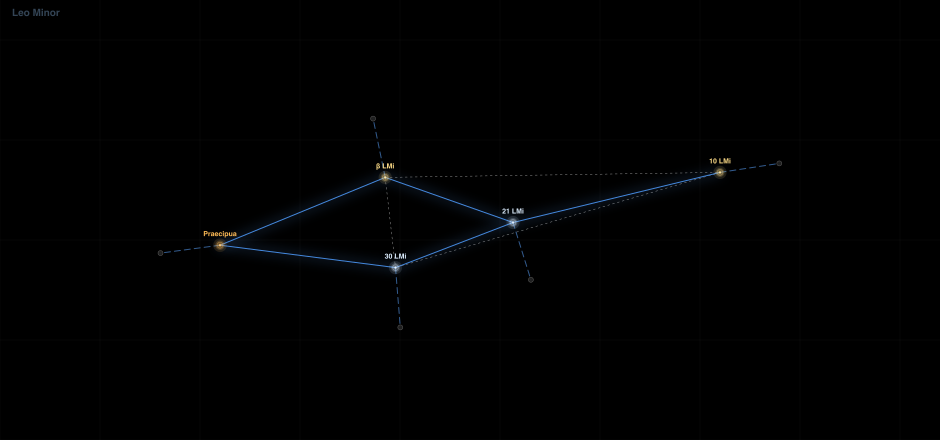
Leo Minor, the Lesser Lion, was introduced by Hevelius in 1687 to fill the space between Leo and Ursa Major. Unusually, its brightest star was never assigned a Greek letter alpha — 46 Leonis Minoris (Praecipua) is its leading light. A modest constellation, it nonetheless contains several interesting galaxies accessible to amateur telescopes.
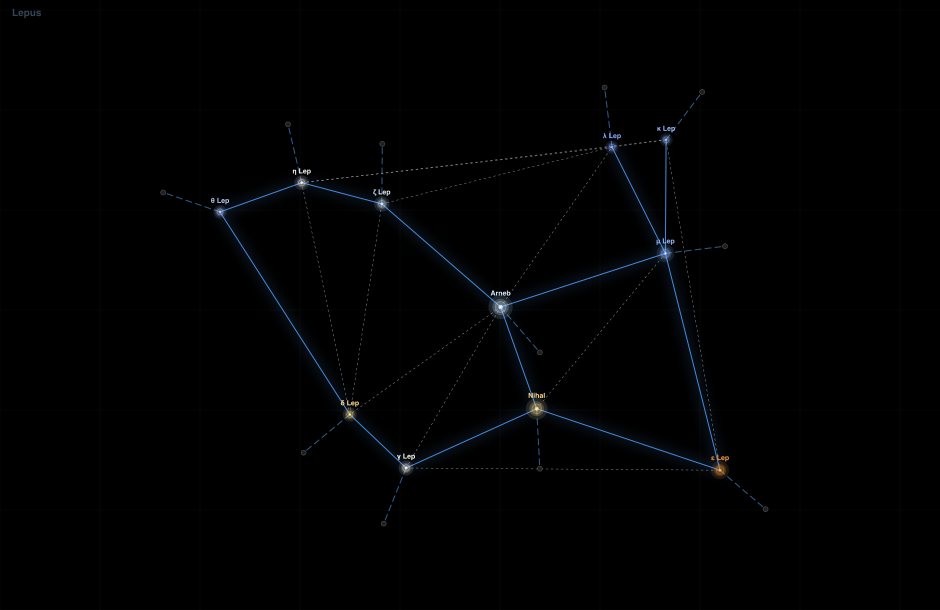
Lepus, the Hare, sits at the feet of Orion, the great hunter. In some traditions it represents the hare being pursued by Orion's hunting dogs, Canis Major and Canis Minor. The constellation contains the famous Crimson Star (R Leporis), one of the reddest stars visible in a small telescope. Lepus was one of Ptolemy's original 48 constellations and is easily spotted in the winter sky.
Greek myth: the hare, prey of Orion
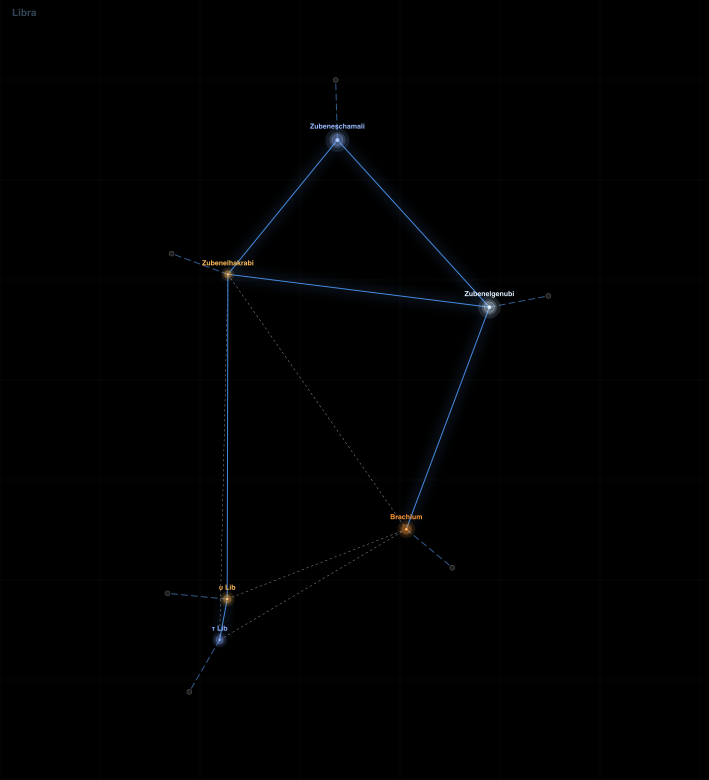
Libra, the Scales, is the only zodiacal constellation representing an inanimate object. The Romans saw it as the scales of justice held by the goddess Astraea (neighbouring Virgo). Its stars were once considered the claws of Scorpius, and their Arabic names — Zubenelgenubi and Zubeneschamali, meaning 'southern claw' and 'northern claw' — preserve this ancient association.
Roman: the scales of justice, associated with Astraea
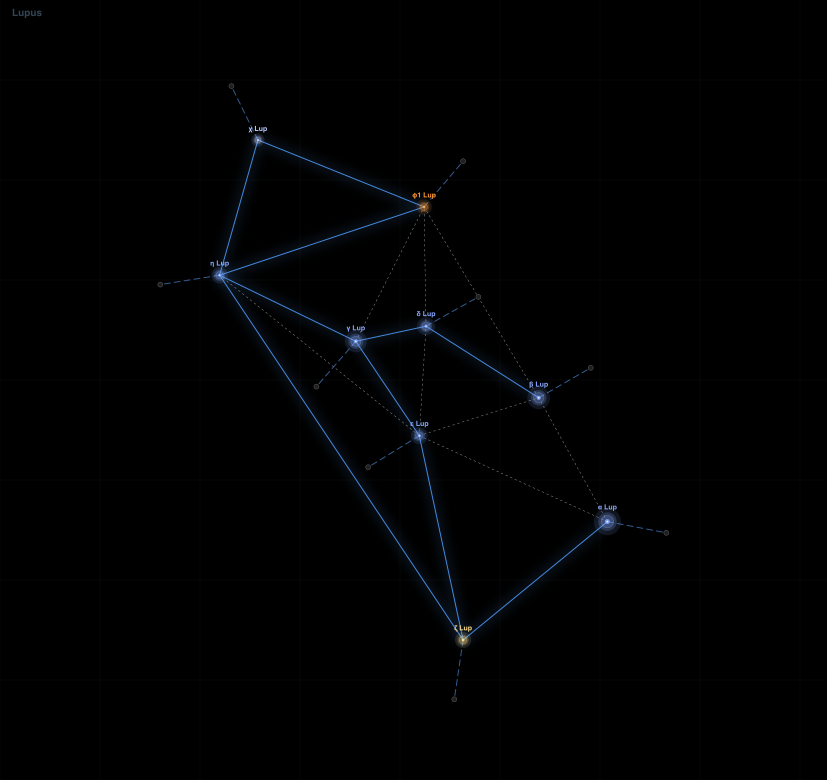
Lupus, the Wolf, was known to the Greeks and Romans as a wild animal impaled on a pole carried by neighbouring Centaurus. It lies in a rich region of the southern Milky Way and was one of Ptolemy's original 48 constellations. A supernova observed in Lupus in 1006 CE was the brightest stellar event in recorded history, visible even during daylight.
Greek/Roman: the wolf, an animal offered in sacrifice
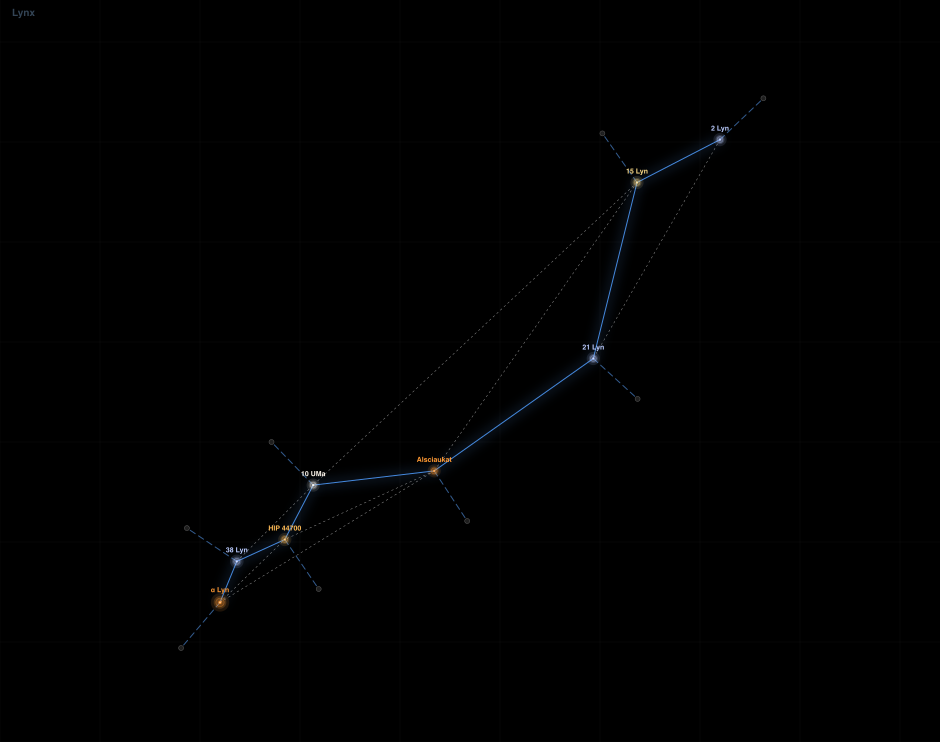
Lynx was introduced by Hevelius in 1687, who remarked that one would need the eyes of a lynx to see its faint stars. It occupies a large but sparse region between Ursa Major, Auriga, and Gemini. Despite its obscurity, Lynx contains several interesting deep-sky objects, including the Intergalactic Wanderer globular cluster (NGC 2419), one of the most remote known.
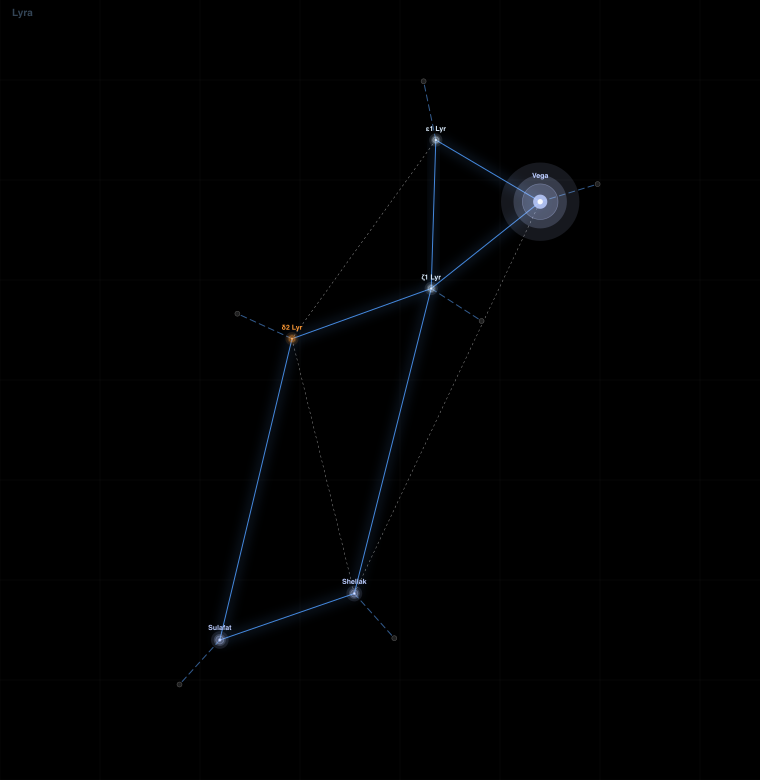
Lyra, the Lyre, represents the musical instrument of Orpheus, whose playing could charm all living things. Its brightest star, Vega, is the fifth-brightest in the sky and forms part of the Summer Triangle with Deneb and Altair. Vega is one of the 58 navigational stars and was the pole star around 12,000 BCE. The constellation also contains the Ring Nebula (M57), a famous planetary nebula.
Greek myth: Orpheus's lyre, music that moved the gods
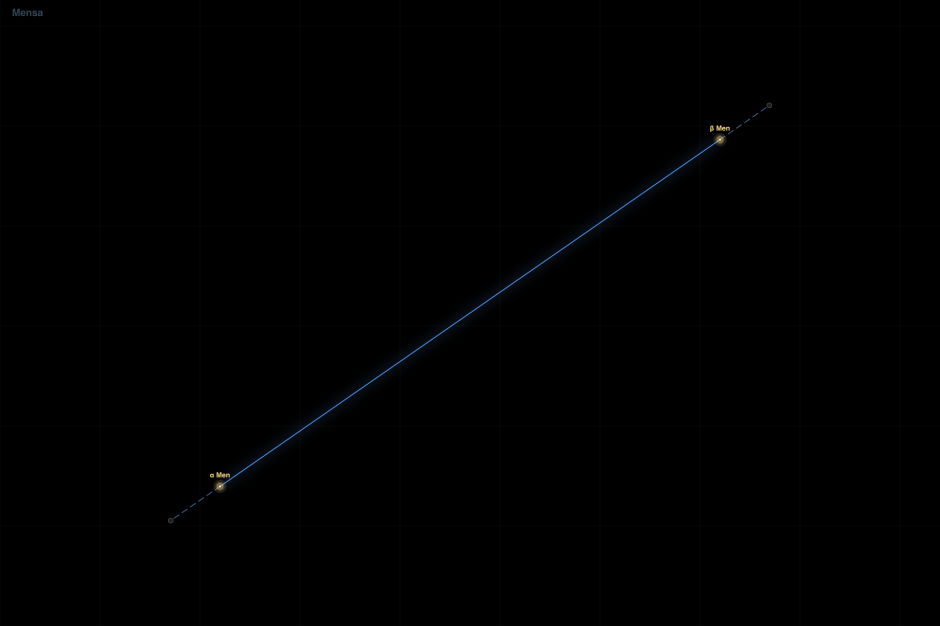
Mensa, Table Mountain, was introduced by Lacaille and is the only constellation named for a terrestrial landmark — Table Mountain in Cape Town, South Africa, where Lacaille conducted his southern sky survey. It is the faintest of all constellations, with no star brighter than fifth magnitude. Part of the Large Magellanic Cloud spills across its border from neighbouring Dorado.
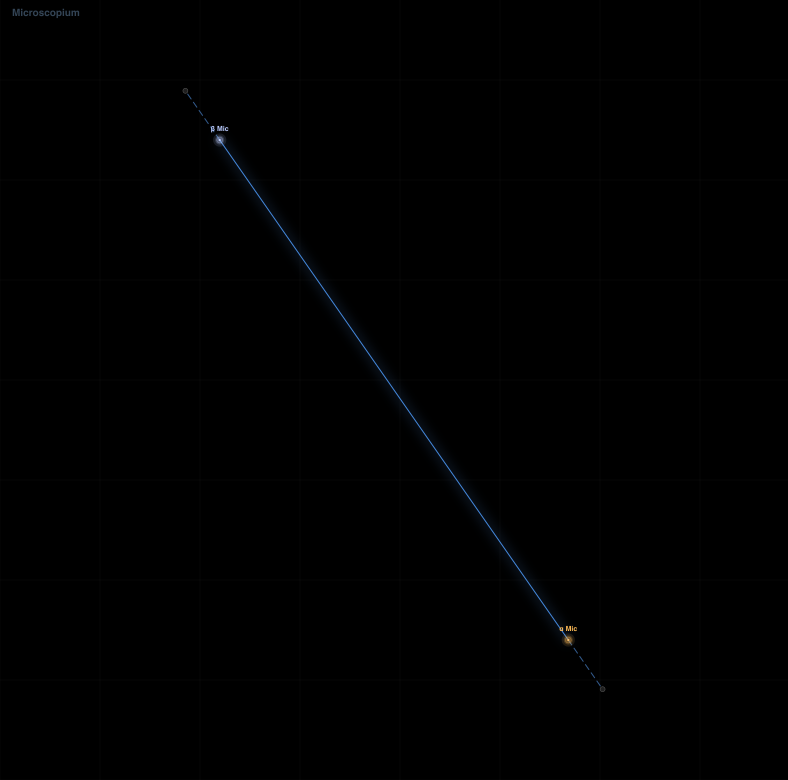
Microscopium, the Microscope, was introduced by Lacaille in honour of the scientific instrument. A faint southern constellation with no stars brighter than fourth magnitude, it represents the Enlightenment's celebration of scientific discovery. Its position south of Capricornus makes it visible from subtropical and southern latitudes during the southern winter.
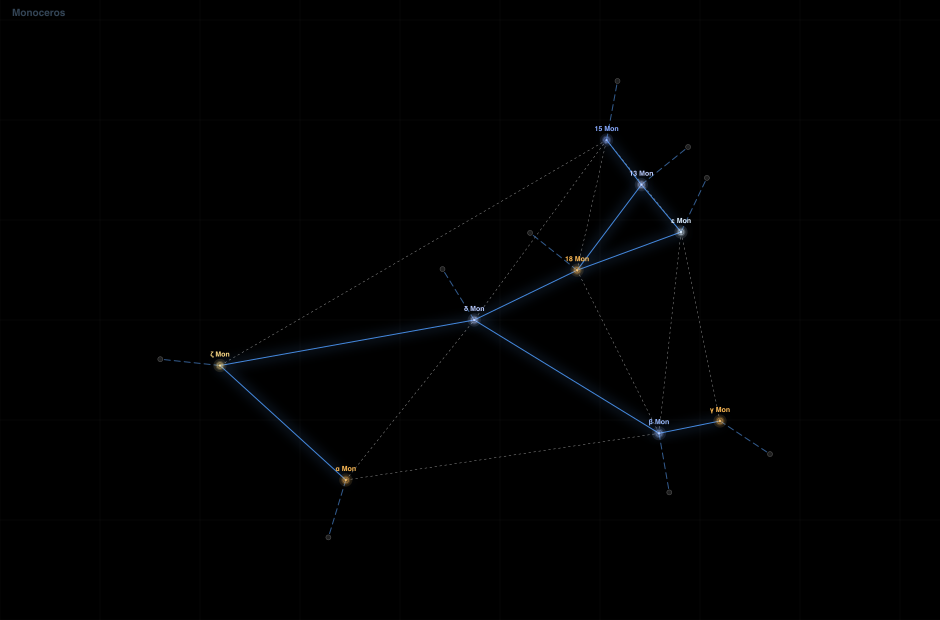
Monoceros, the Unicorn, was formally introduced by Petrus Plancius in 1612, though it may have older origins. Straddling the celestial equator within the Winter Triangle of Sirius, Procyon, and Betelgeuse, its Milky Way fields are exceptionally rich. Monoceros hosts the Rosette Nebula and several fine open clusters, making it a showpiece region despite its lack of bright stars.
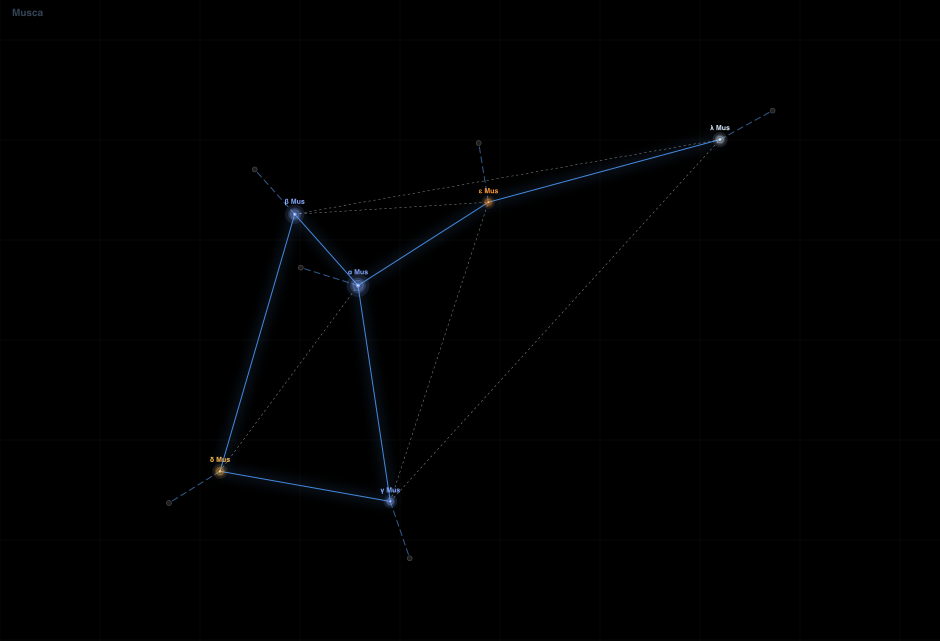
Musca, the Fly, was originally 'Apis' (the Bee) when introduced by Keyser and de Houtman. It lies immediately south of Crux and was visible to every navigator who used the Southern Cross for orientation. Though small, Musca sits in a rich region of the southern Milky Way and contains several globular clusters. It is the only insect among the 88 constellations.
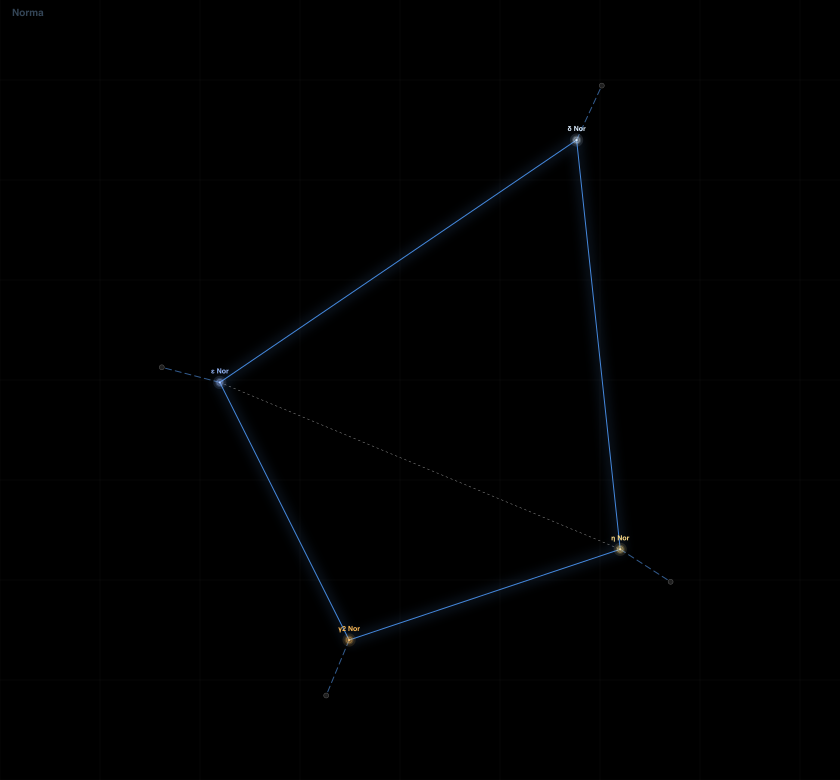
Norma, the Carpenter's Square (or Set Square), was introduced by Lacaille. Originally named 'the Level and Square', it represents the tools of builders and craftsmen. It lies in a rich part of the southern Milky Way near Scorpius and contains several fine open clusters. Norma lost some of its brighter stars when constellation boundaries were formally redrawn by the IAU in 1930.
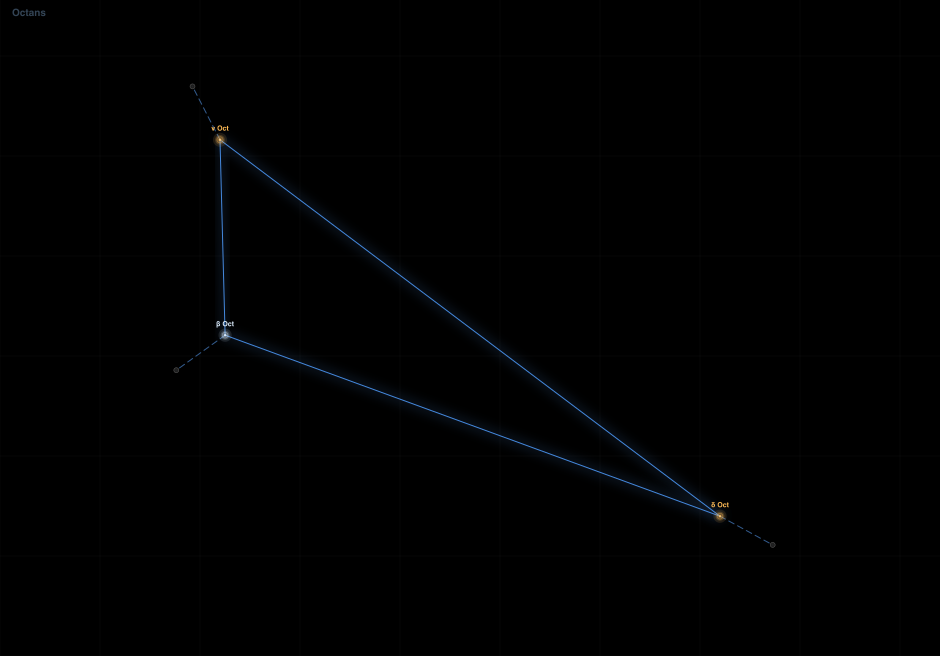
Octans, the Octant, was introduced by Lacaille and represents the navigational instrument invented by John Hadley in 1731 — the precursor to the sextant that every mariner carried. Fittingly, Octans contains the south celestial pole, though its pole star, Sigma Octantis, is barely visible at magnitude 5.4. The SS Great Britain's navigators would have appreciated this tribute to their essential tool.
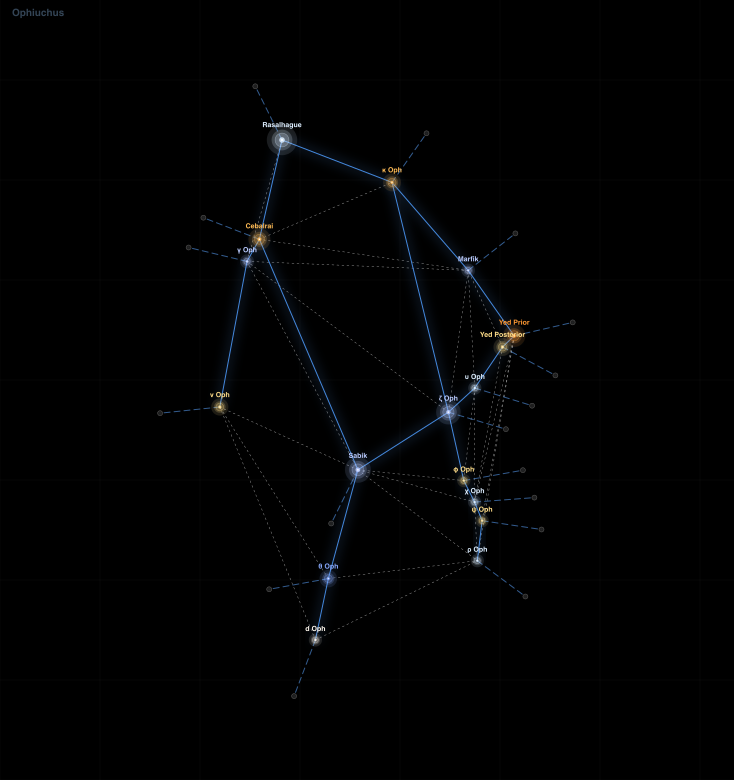
Ophiuchus, the Serpent Bearer, represents Asclepius, the Greek god of medicine, who learned the secret of immortality by observing a serpent revive its dead companion with herbs. Though not traditionally counted among the zodiacal constellations, the sun passes through Ophiuchus each December. Its brightest star, Rasalhague, is one of the 58 navigational stars.
Greek myth: Asclepius, the healer who could resurrect the dead
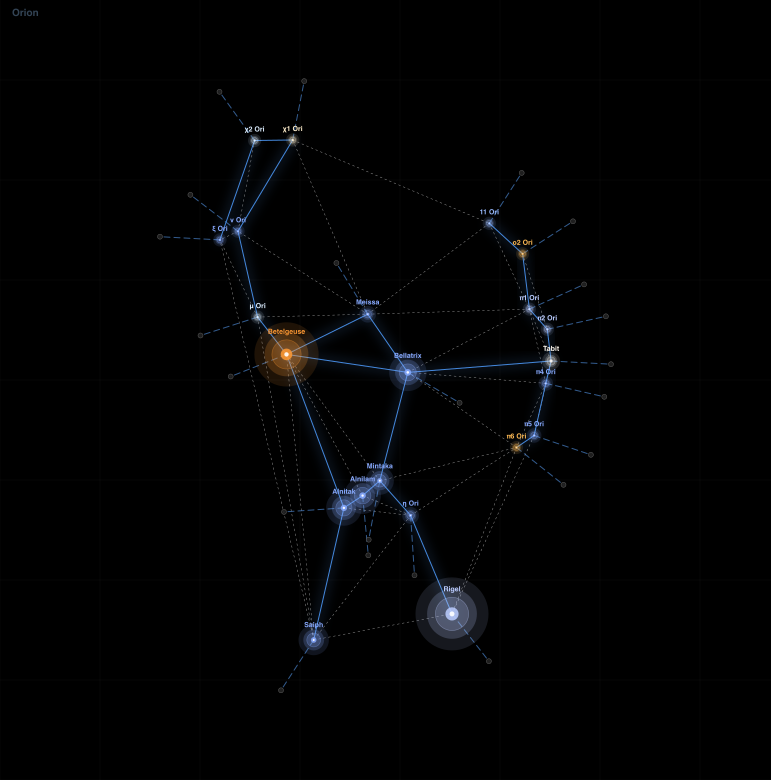
Orion, the Hunter, is perhaps the most universally recognised constellation, visible from every inhabited part of the Earth. His belt of three bright stars has been a landmark of the winter sky since the earliest human civilisations. Rigel and Betelgeuse, marking the hunter's foot and shoulder, are both among the 58 navigational stars and have guided countless sailors across every ocean. The SS Great Britain's crew would have seen Orion striding above the bow on winter departures from Liverpool.
Greek myth: the great hunter, son of Poseidon
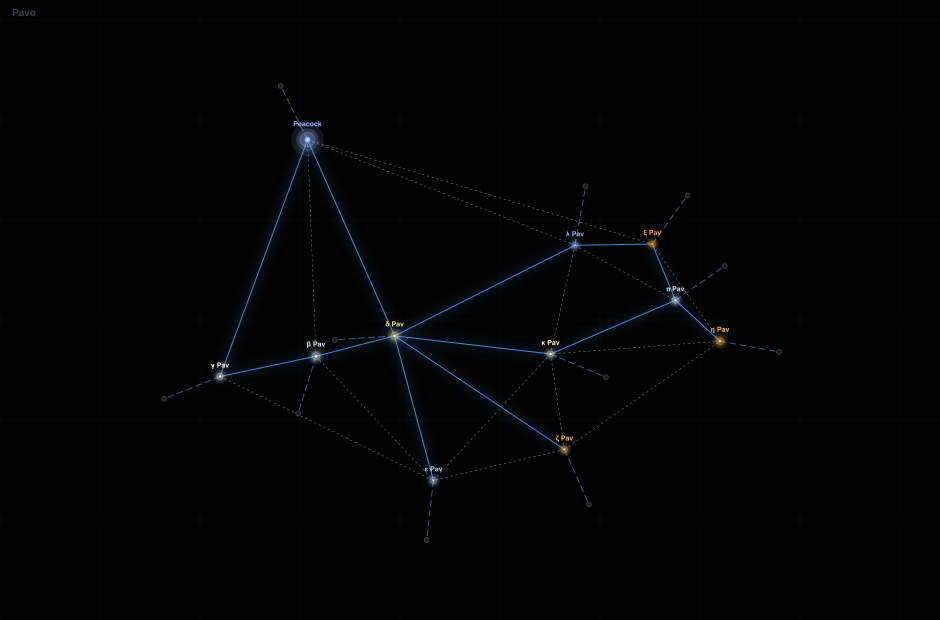
Pavo, the Peacock, was introduced by Keyser and de Houtman during their southern voyages. Its brightest star, Peacock (Alpha Pavonis), is one of the 58 navigational stars and was a vital reference for ships in the southern Indian Ocean. In Greek myth, the peacock was sacred to Hera, its tail feathers decorated with the hundred eyes of the giant Argus who had guarded the maiden Io.
Greek myth: the peacock of Hera, adorned with Argus's eyes
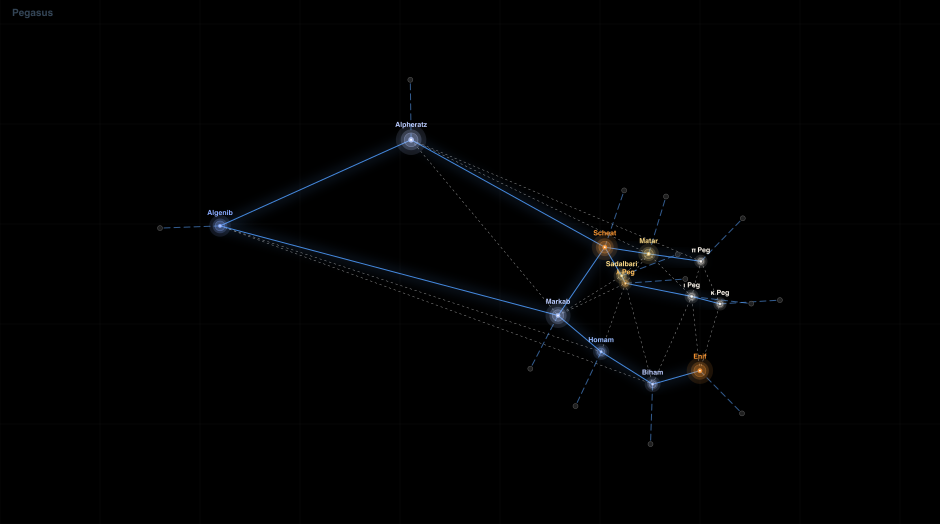
Pegasus, the Winged Horse, is dominated by the Great Square, a massive asterism that served as a seasonal marker for ancient navigators — when the Square stood high overhead, it signalled autumn in the northern hemisphere. The constellation's brightest stars, Markab and Enif, are navigational stars. In Greek myth, Pegasus sprang from the blood of Medusa when Perseus slew her over the sea.
Greek myth: the winged horse born from Medusa's blood
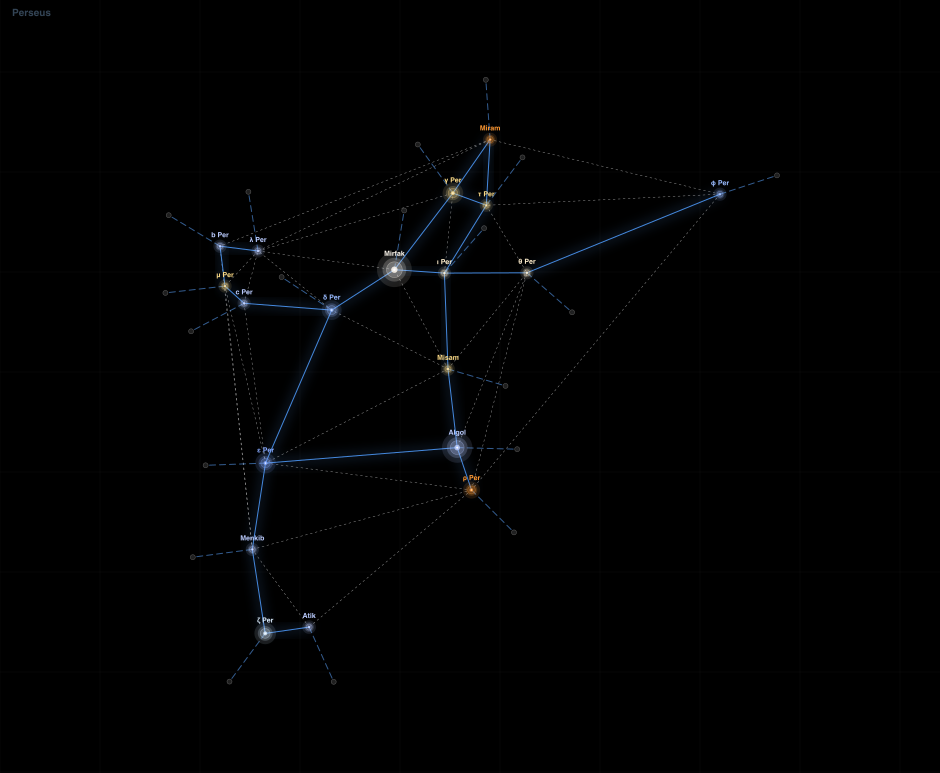
Perseus, the Hero, represents the slayer of Medusa who rescued Andromeda from the sea monster Cetus. The constellation contains Algol, the 'Demon Star', whose regular eclipses were noted by ancient astronomers and gave rise to its sinister reputation. Each August, the Perseid meteor shower radiates from this constellation, one of the most reliable and spectacular annual meteor displays.
Greek myth: hero who slew Medusa and rescued Andromeda
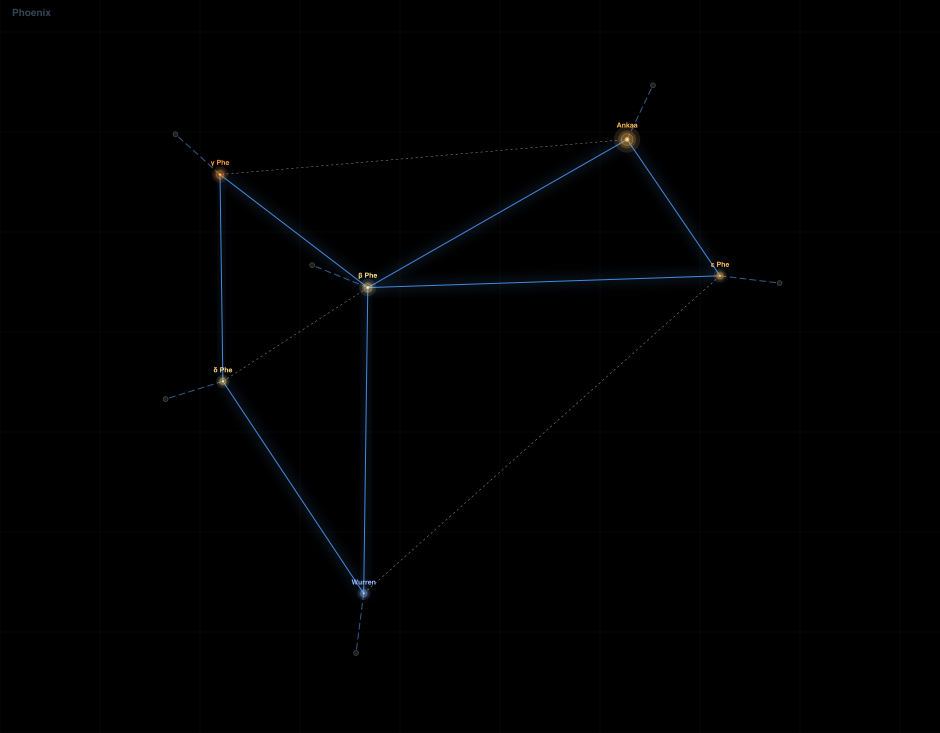
Phoenix, the mythical firebird that rises from its own ashes, was introduced by Keyser and de Houtman. Its brightest star, Ankaa, is one of the 58 navigational stars used for celestial fixes. The phoenix was a powerful symbol of renewal and rebirth in ancient Egyptian, Greek, and Chinese cultures. Ankaa would have been a useful guide star for the SS Great Britain when sailing in southern waters.
Mythological: the bird reborn from fire
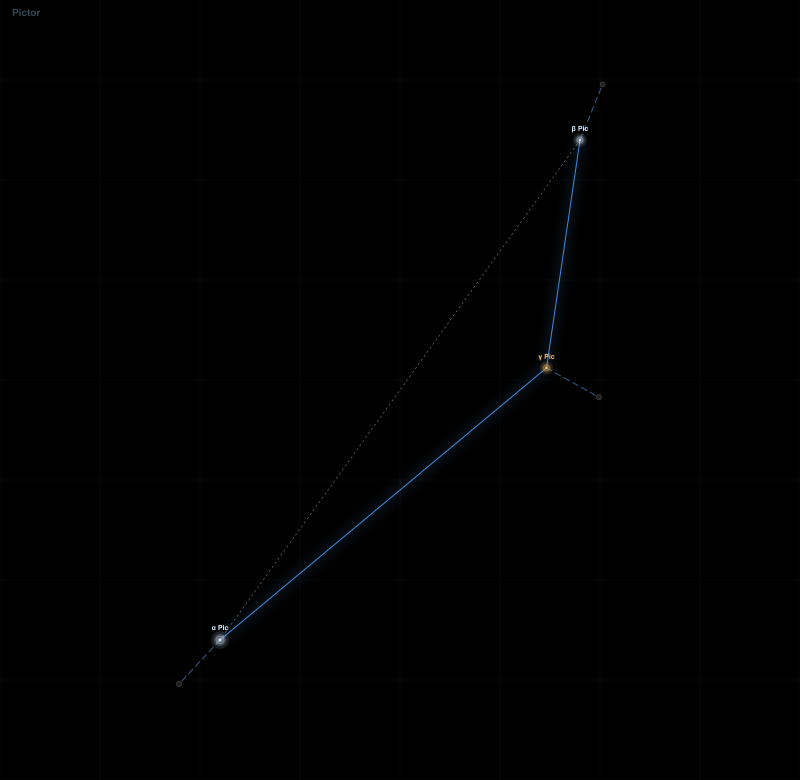
Pictor, the Painter's Easel, was introduced by Lacaille, originally as 'Equuleus Pictoris'. Though faint, it hosts Beta Pictoris, one of the most scientifically important stars in the sky — the first star around which a circumstellar debris disc was directly imaged, providing evidence of planetary formation in action. Beta Pictoris is now known to harbour at least two exoplanets.
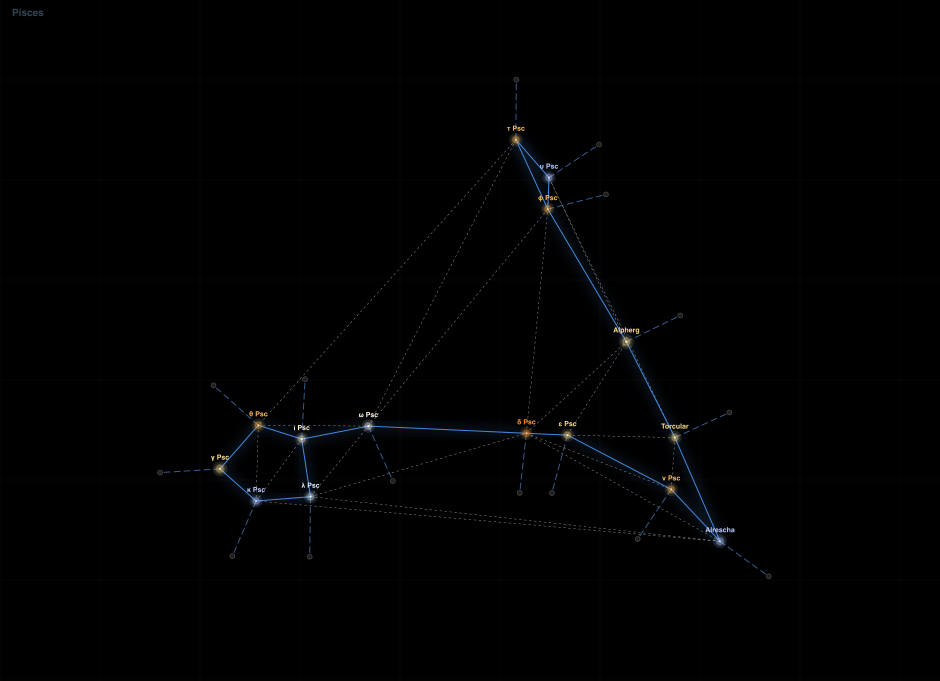
Pisces, the Fishes, represents the two fish into which Aphrodite and Eros transformed to escape the monster Typhon, tied together by a cord so they would not lose each other in the sea. The vernal equinox currently lies within Pisces, making it the starting point for the modern celestial coordinate system. Despite this significance, its stars are faint and the constellation can be difficult to trace.
Greek myth: Aphrodite and Eros transformed to escape Typhon
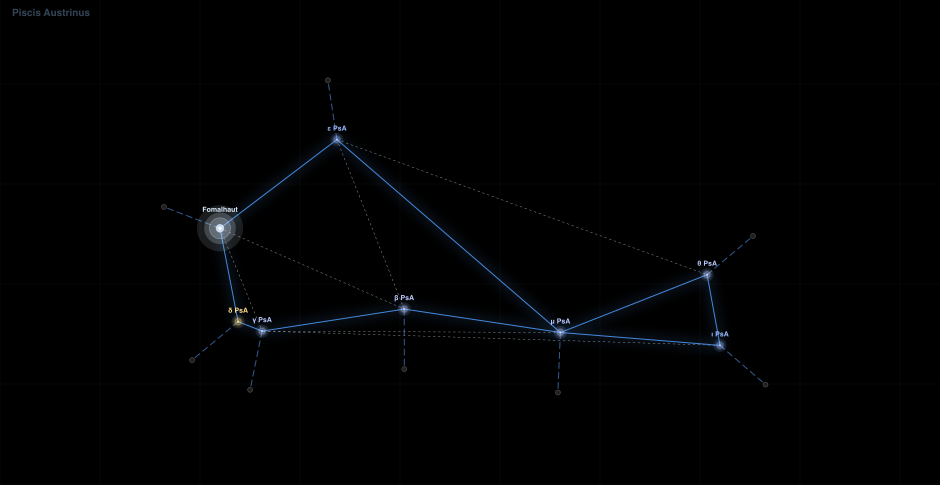
Piscis Austrinus, the Southern Fish, is an ancient constellation known to the Babylonians and Greeks. Its brightest star, Fomalhaut, the 'Mouth of the Fish', is one of the 58 navigational stars and one of the first stars around which an exoplanet was directly imaged by the Hubble Space Telescope. Fomalhaut shines as a solitary beacon in an otherwise sparse region of the autumn sky.
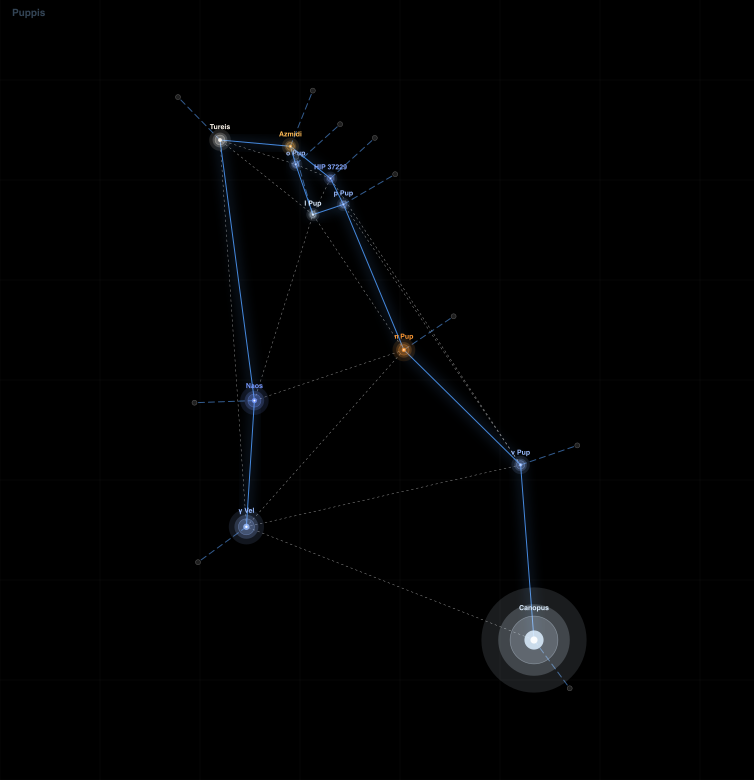
Puppis, the Stern (or Poop Deck), was part of the ancient mega-constellation Argo Navis before Lacaille divided it. Representing the stern of Jason's ship, it is especially apt for an installation at a ship museum. Its brightest star, Naos (Zeta Puppis), is one of the hottest and most luminous stars visible to the naked eye. Several rich open clusters populate this Milky Way constellation.
Part of Argo Navis: the stern deck of Jason's ship
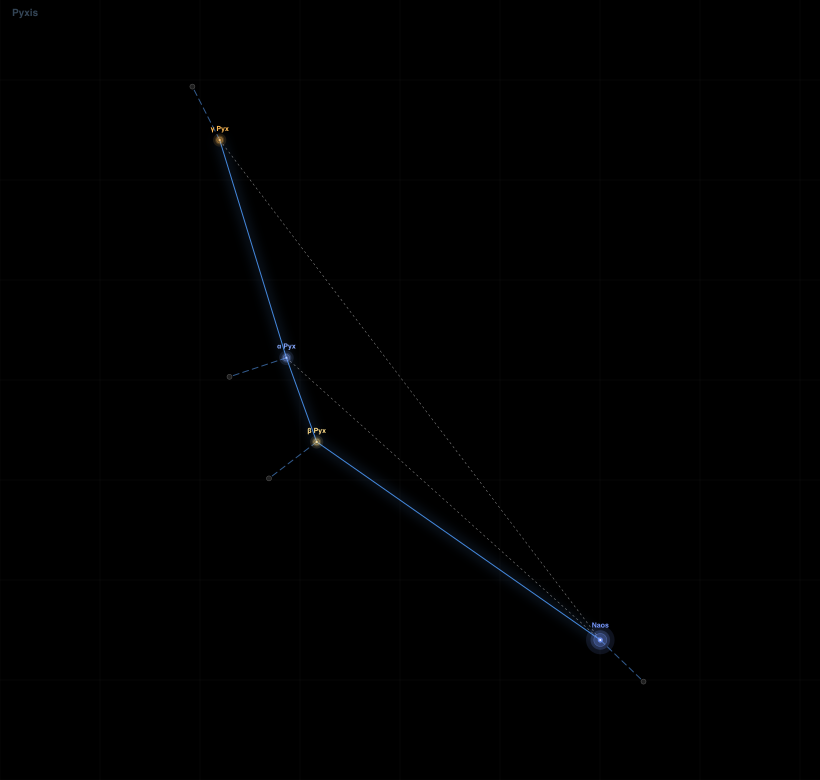
Pyxis, the Compass (the mariner's compass), was created by Lacaille near the remnants of Argo Navis. Though not technically part of the original Argo, its navigational theme is unmistakable — the compass that guided the Argonauts. For an installation celebrating the connection between ships and stars, Pyxis is a particularly meaningful choice. It contains the recurrent nova T Pyxidis.
Maritime: the mariner's compass
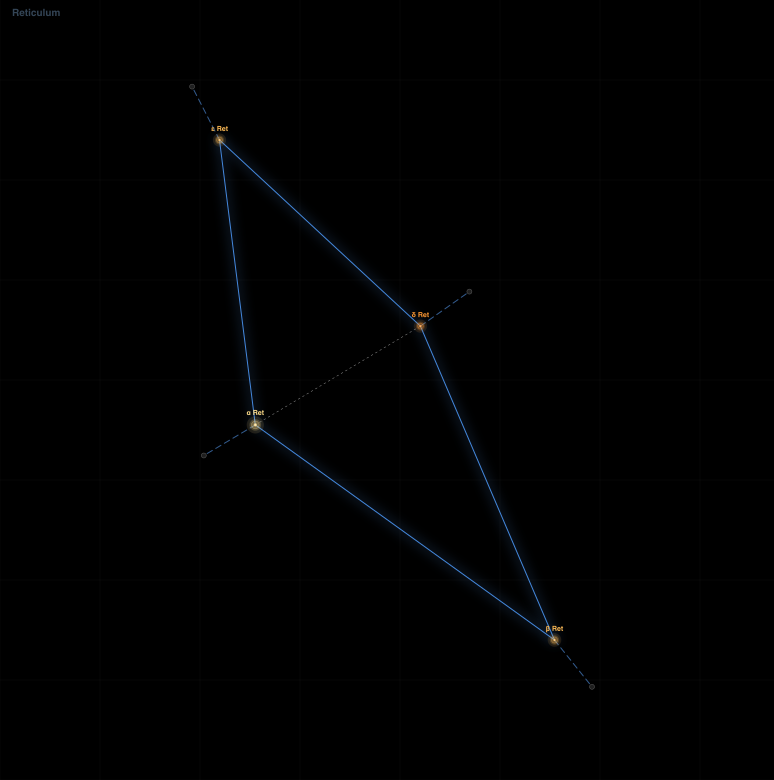
Reticulum, the Reticle (the eyepiece crosshairs of a telescope), was introduced by Lacaille to honour the instrument he used to measure star positions during his southern survey. A small and faint constellation, it lies near the Large Magellanic Cloud. Lacaille's meticulous work from the Cape of Good Hope charted nearly ten thousand southern stars, vastly expanding European knowledge of the southern sky.
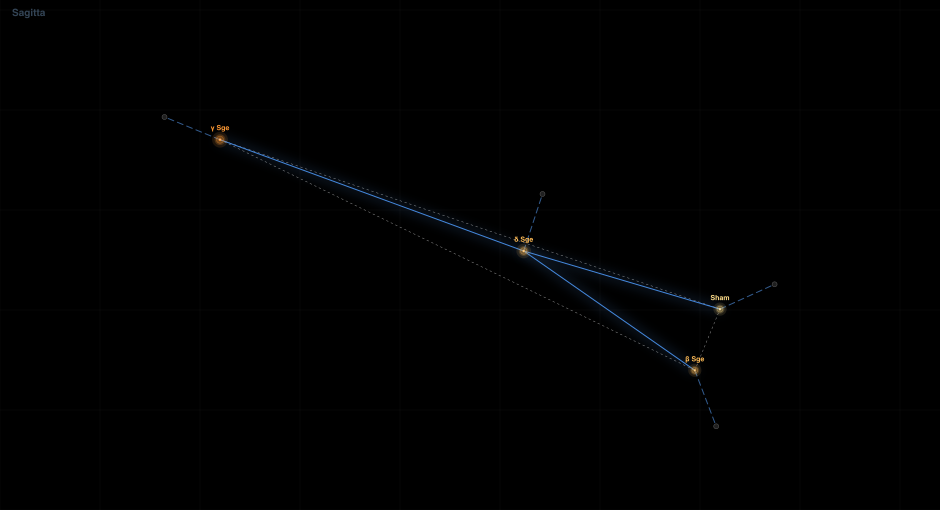
Sagitta, the Arrow, is the third-smallest constellation but was one of the original 48 listed by Ptolemy. Various myths identify it as the arrow of Heracles, or the weapon Apollo used to slay the Cyclopes. Despite its small size, its compact shape makes it easy to find in the Milky Way between Aquila and Cygnus. It contains the notable globular cluster M71.
Greek myth: the arrow of Hercules or Apollo
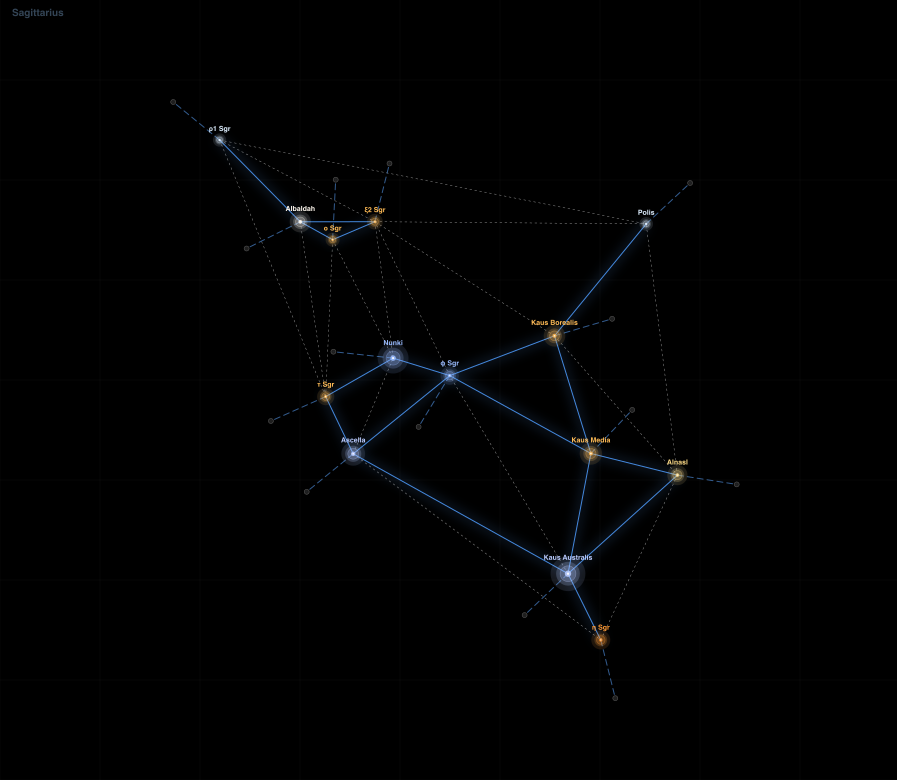
Sagittarius, the Archer, is a centaur aiming his bow towards the heart of Scorpius. The centre of our Milky Way galaxy lies within its borders, making this one of the richest regions in the sky for nebulae and star clusters. Its 'Teapot' asterism is one of the most recognisable patterns in the summer sky. Nunki and Kaus Australis are among its navigational stars.
Greek myth: the archer centaur
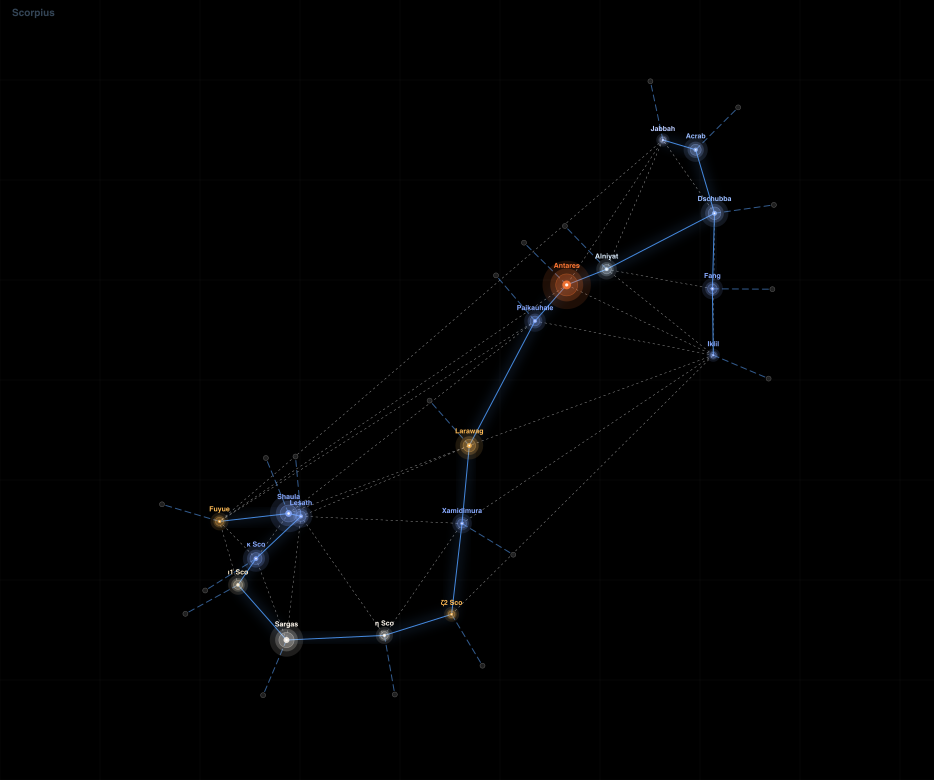
Scorpius, the Scorpion, is one of the few constellations that truly resembles its namesake, with the brilliant red supergiant Antares marking its heart and a curving tail of stars ending in a pair of stingers. Antares, whose name means 'rival of Mars', is one of the 58 navigational stars. In Greek myth, it was the scorpion sent by Gaia to slay the hunter Orion — the two are placed on opposite sides of the sky so they never appear together.
Greek myth: the scorpion that slew Orion
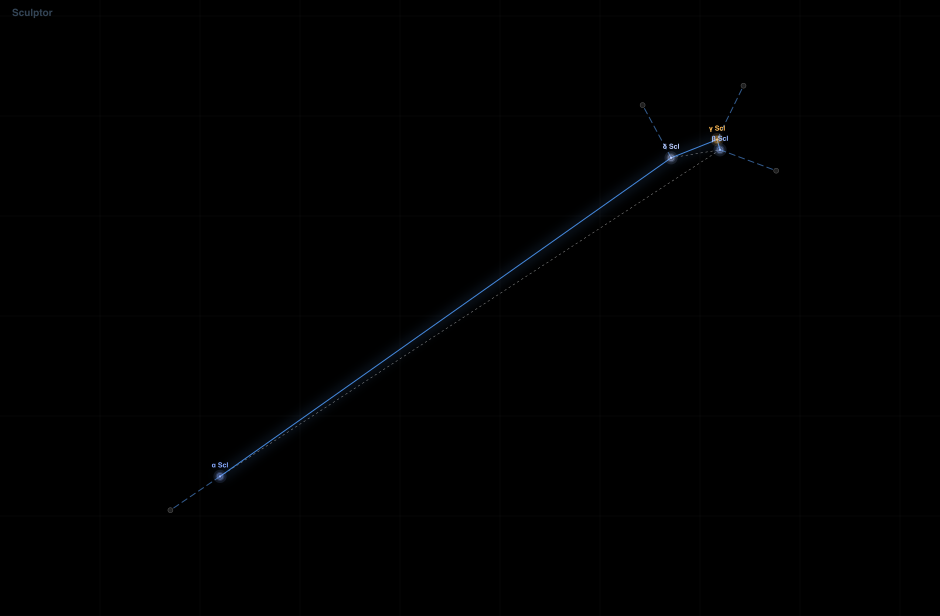
Sculptor, the Sculptor's Studio, was introduced by Lacaille as 'the Sculptor's Workshop'. Though faint, it contains the south galactic pole and is home to the Sculptor Dwarf Galaxy, one of the nearest dwarf galaxies to the Milky Way. NGC 253, the Silver Dollar Galaxy, is the constellation's showpiece — one of the brightest galaxies visible from the southern hemisphere.
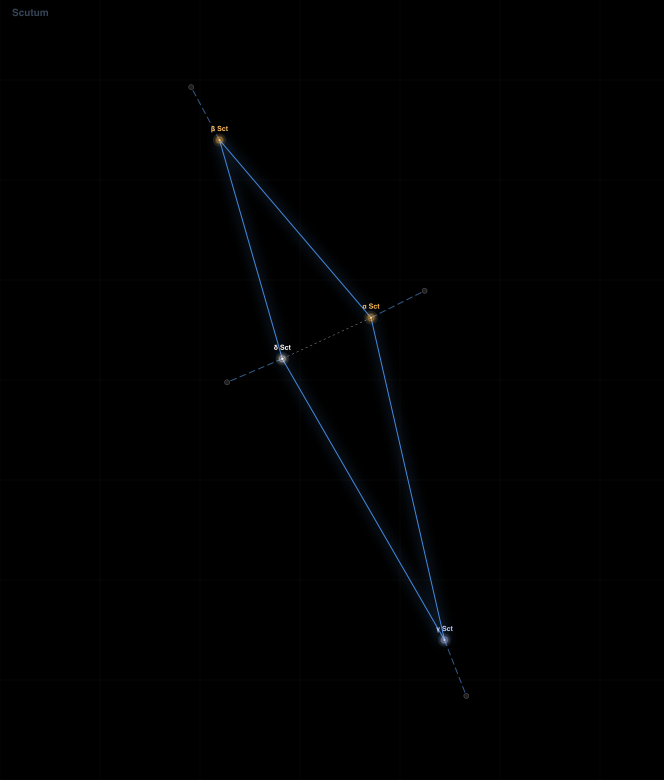
Scutum, the Shield, was introduced by Hevelius in 1684 as 'Scutum Sobiescianum' to honour the Polish King John III Sobieski and his victory at the Battle of Vienna. It is the only constellation created to commemorate a specific historical event. Despite its small size, Scutum lies in a dense part of the Milky Way and contains the Wild Duck Cluster (M11), one of the richest open clusters known.
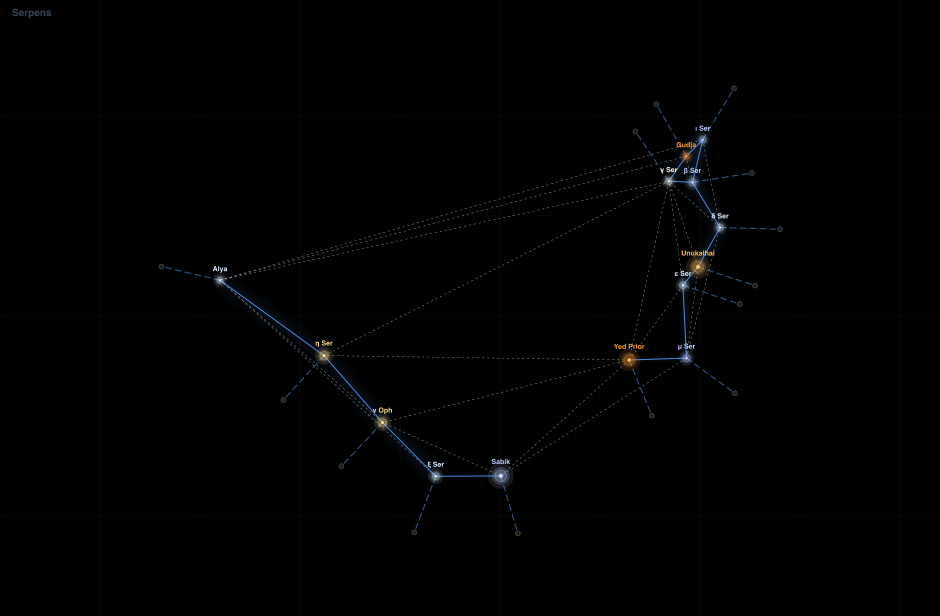
Serpens, the Serpent, is unique among the 88 constellations in being divided into two separate parts — Serpens Caput (the head) and Serpens Cauda (the tail) — separated by Ophiuchus. It represents the snake held by Asclepius, the healer. Serpens Cauda contains the Eagle Nebula (M16), home to the famous 'Pillars of Creation' imaged by the Hubble Space Telescope.
Greek myth: the serpent held by Asclepius, symbol of healing
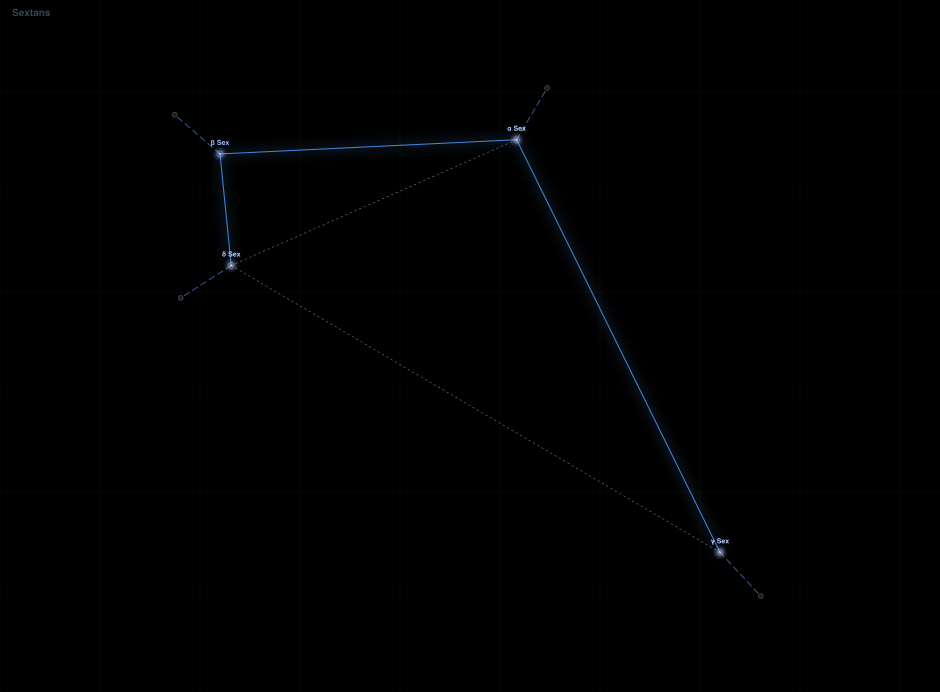
Sextans, the Sextant, was introduced by Hevelius to commemorate his favourite astronomical instrument, lost when his observatory burned down in 1679. The sextant — and its predecessor the octant — was the essential tool of celestial navigation, used on every ocean-going vessel including the SS Great Britain. The constellation thus honours the very instrument that connected mariners to the stars above.
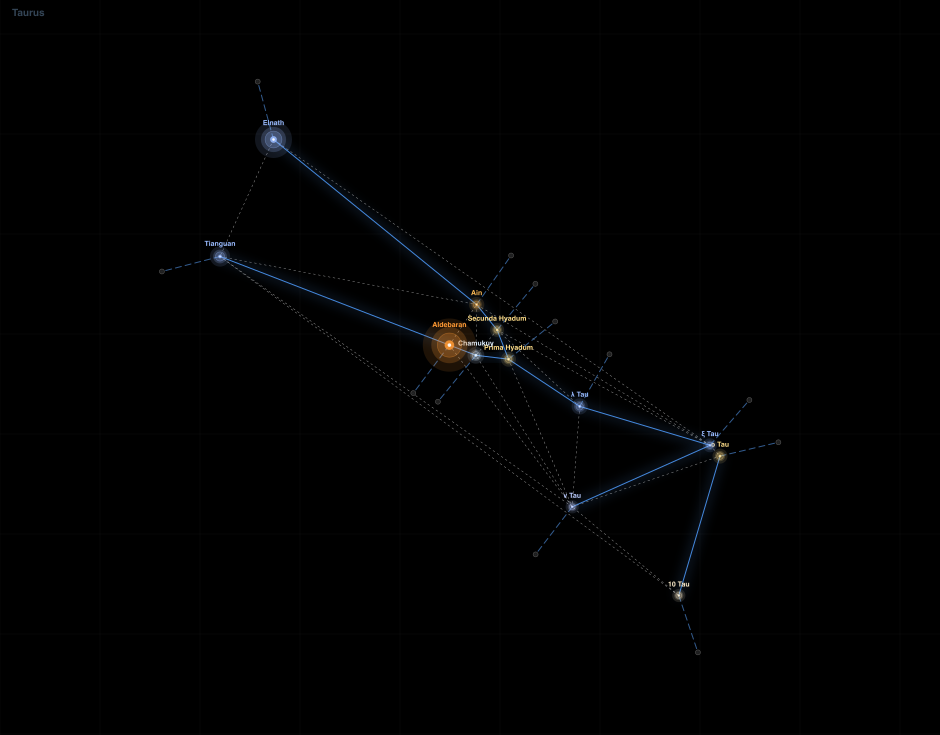
Taurus, the Bull, is one of the oldest constellations, depicted on cave paintings dating back 17,000 years. Its baleful orange eye, Aldebaran, is one of the 58 navigational stars and has guided sailors since the Phoenicians first ventured into the open Mediterranean. Taurus hosts the Pleiades and Hyades star clusters, both important seasonal markers for ancient maritime cultures. The Crab Nebula (M1), remnant of a supernova observed in 1054 CE, lies near the tip of the bull's southern horn.
Greek myth: Zeus as a bull, abduction of Europa
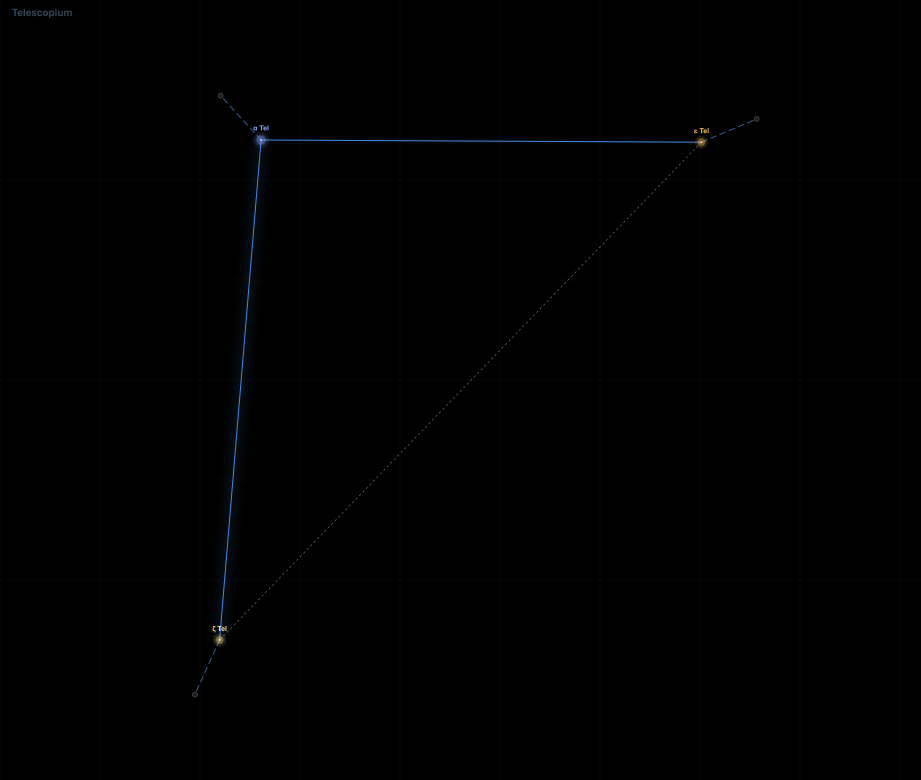
Telescopium, the Telescope, was introduced by Lacaille to honour the instrument that transformed astronomy. A faint constellation in the southern sky near Sagittarius and Corona Australis, it contains no stars brighter than fourth magnitude. Lacaille's choice to memorialise scientific instruments in the sky reflects the Enlightenment's deep respect for the tools of discovery.
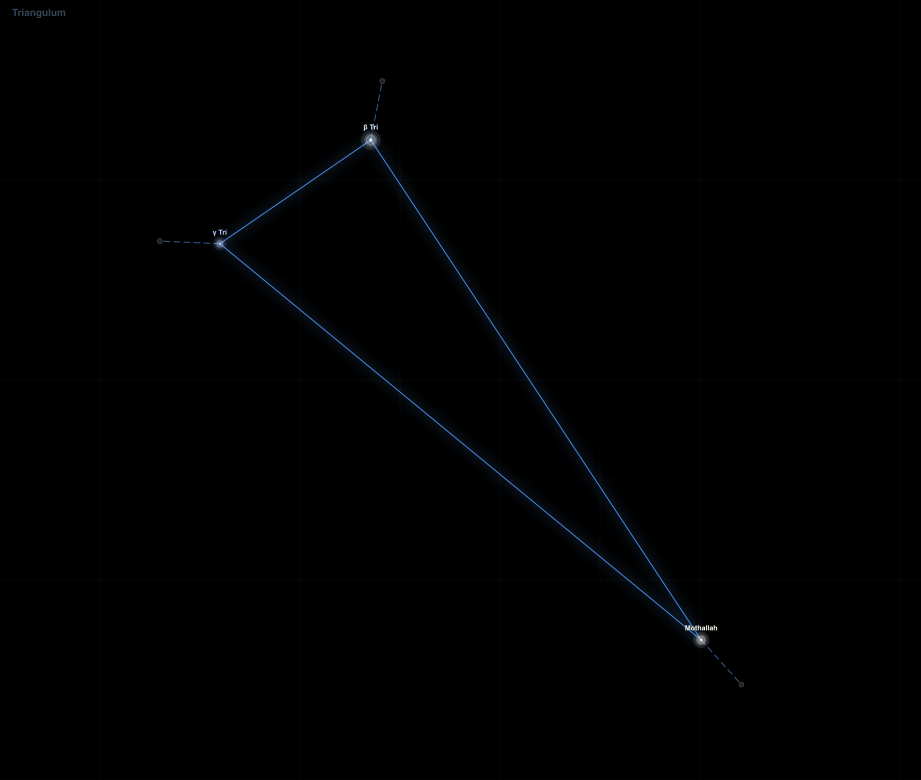
Triangulum, the Triangle, is a small but ancient northern constellation, known to the Greeks as 'Deltoton' for its resemblance to the letter delta. It hosts the Triangulum Galaxy (M33), the third-largest member of the Local Group of galaxies and one of the most distant objects visible to the naked eye under excellent conditions. Ptolemy listed Triangulum among his original 48 constellations.
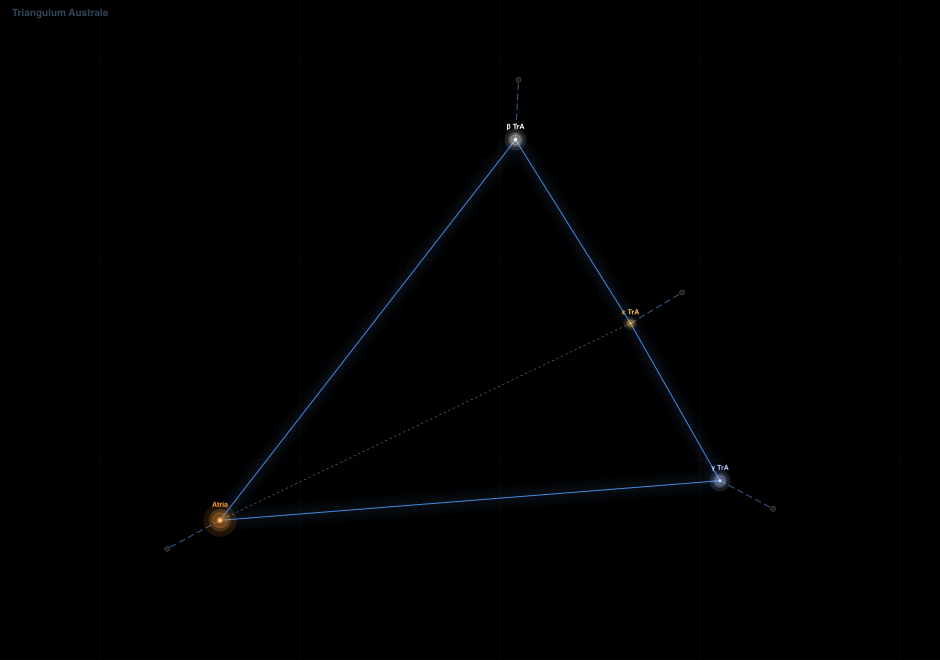
Triangulum Australe, the Southern Triangle, was introduced by Keyser and de Houtman and is one of the brightest of the southern constellations added during the Age of Exploration. Its three stars form a nearly equilateral triangle that served as a useful reference pattern for navigators in southern waters. It lies near Alpha and Beta Centauri in a rich region of the southern Milky Way.
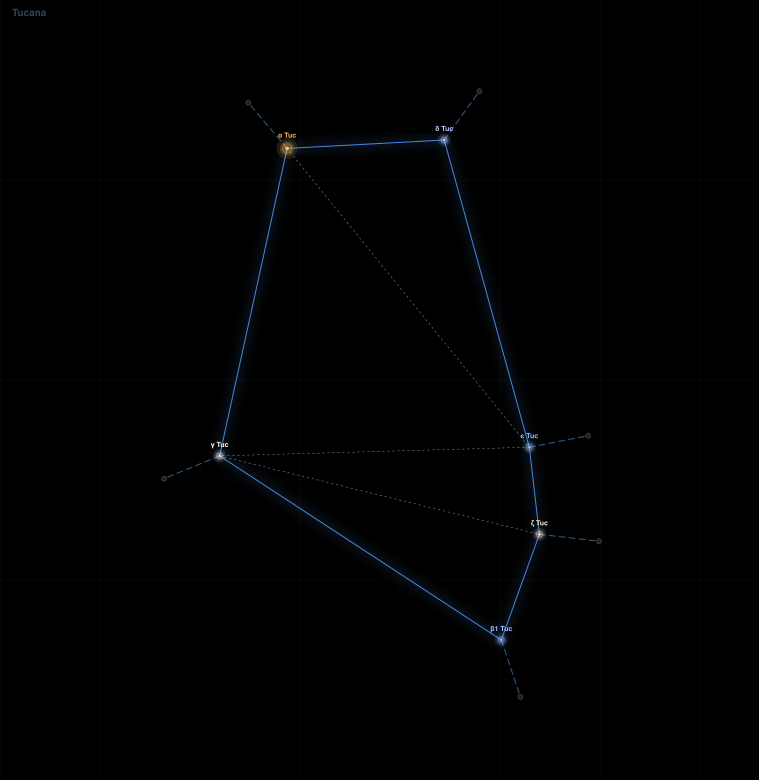
Tucana, the Toucan, was introduced by Keyser and de Houtman, representing the colourful tropical bird encountered during European exploration of the Americas. Its most famous feature is 47 Tucanae (NGC 104), one of the finest globular clusters in the sky and second only to Omega Centauri. Tucana also hosts the Small Magellanic Cloud, a satellite galaxy visible as a luminous patch from southern latitudes.
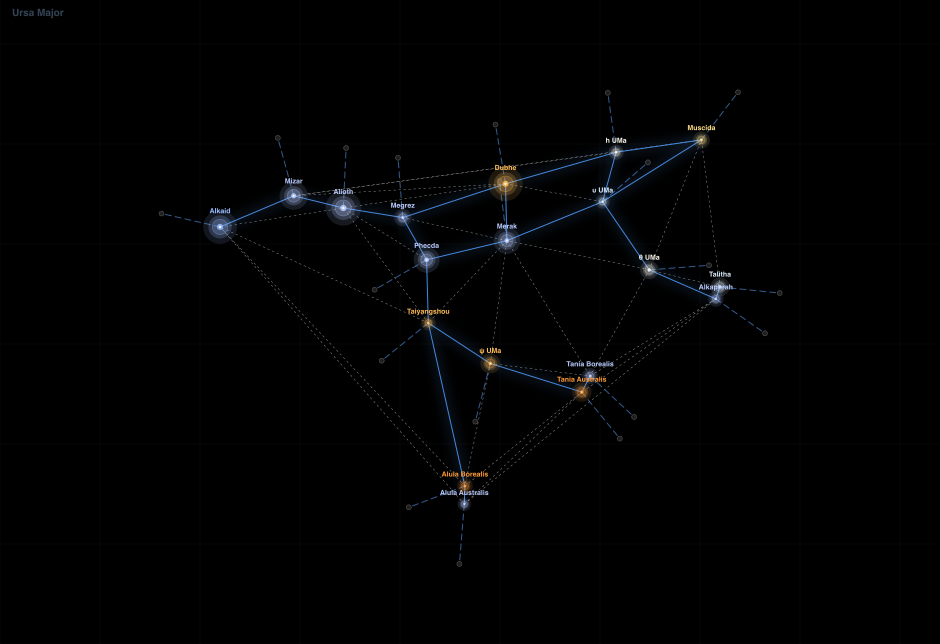
Ursa Major, the Great Bear, contains the Plough (or Big Dipper), perhaps the most recognised asterism in the northern sky. For millennia, its pointer stars Dubhe and Merak have guided navigators to Polaris and true north. The SS Great Britain's officers would have used this technique on every voyage. In myth, Zeus placed the nymph Callisto in the sky as a bear to protect her from Hera's wrath. Circumpolar from Bristol, Ursa Major is visible every night of the year.
Greek myth: Callisto transformed into a bear by Zeus
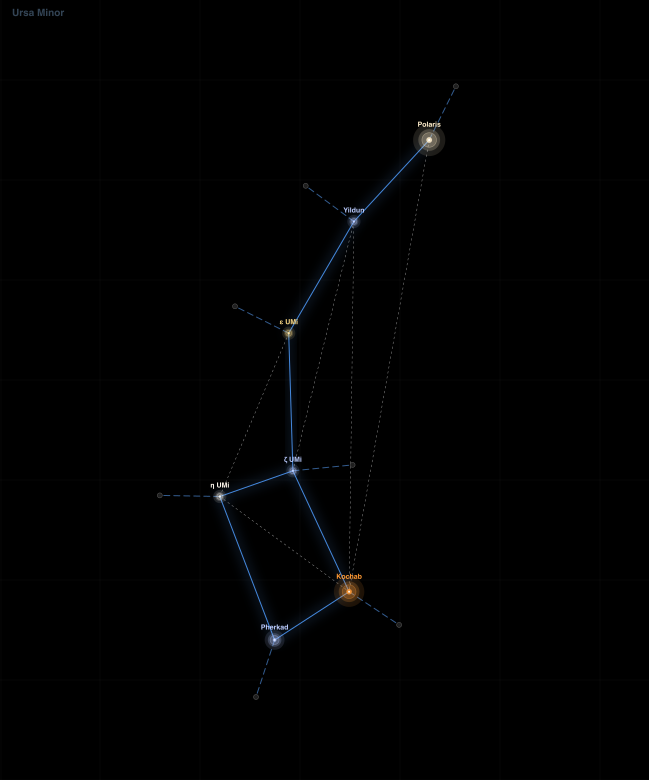
Ursa Minor, the Little Bear, contains Polaris, the current North Star and the most important single star in the history of navigation. For over a thousand years, Polaris has enabled mariners to determine their latitude simply by measuring its altitude above the horizon. Every captain who sailed from Bristol, including those of the SS Great Britain, relied on Polaris until it sank below the horizon as the ship crossed into the southern hemisphere.
Greek myth: Arcas, son of Callisto, also transformed
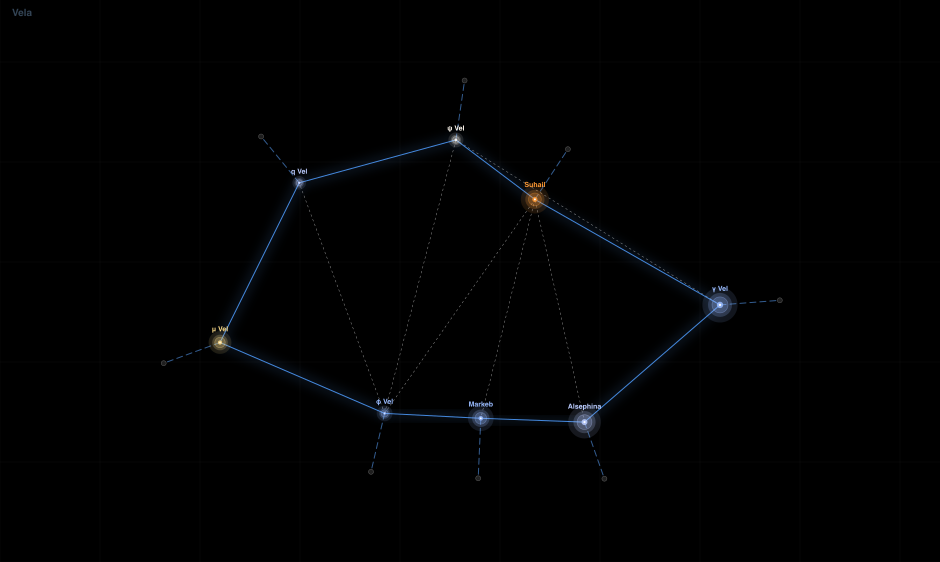
Vela, the Sails, was part of the ancient Argo Navis constellation before Lacaille divided it. Representing the sails of the Argonauts' ship, Vela is wonderfully appropriate for an installation at the SS Great Britain, one of the first great iron-hulled, screw-propelled ships that nevertheless still carried sails. Its stars would have been visible throughout the ship's southern-ocean passages, and its brightest star, Alsephina (Delta Velorum), is a navigational star.
Part of Argo Navis: the sails of Jason's ship the Argo
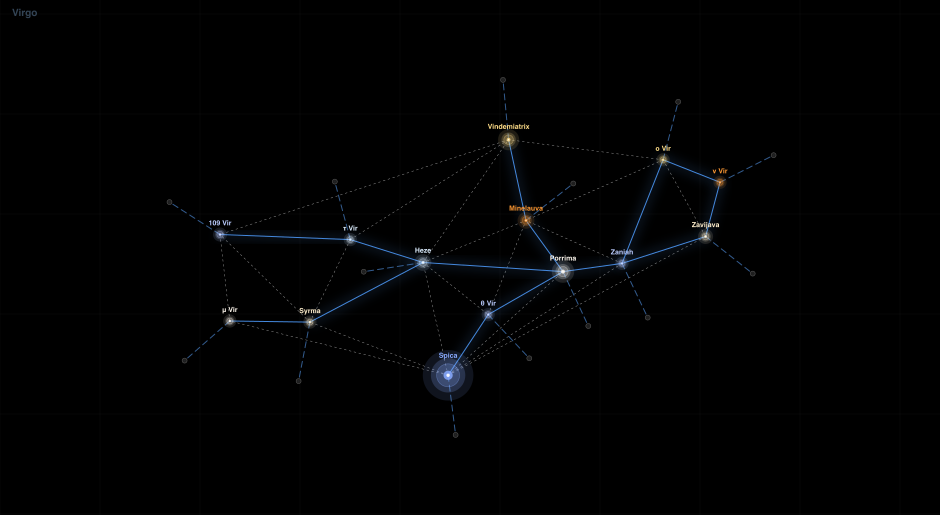
Virgo, the Maiden, is the second-largest constellation and the only female figure among the zodiac. Associated with Demeter, Persephone, or Astraea the goddess of justice, Virgo's brightest star, Spica, is one of the 58 navigational stars — its name means 'ear of grain'. The Virgo Cluster of galaxies, containing over a thousand members, lies within its borders and represents the heart of our local supercluster.
Greek myth: Astraea or Demeter, goddess of the harvest
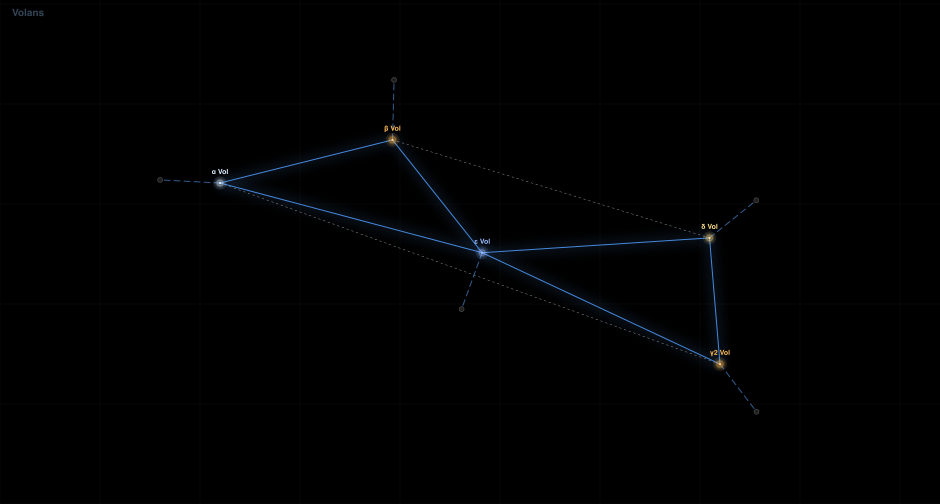
Volans, the Flying Fish, was introduced by Keyser and de Houtman, representing the flying fish that sailors frequently observed leaping from tropical waters. It would have been a familiar sight to the passengers and crew of the SS Great Britain in warmer latitudes. A small and faint constellation near Carina and Pictor, it lies deep in the southern sky.
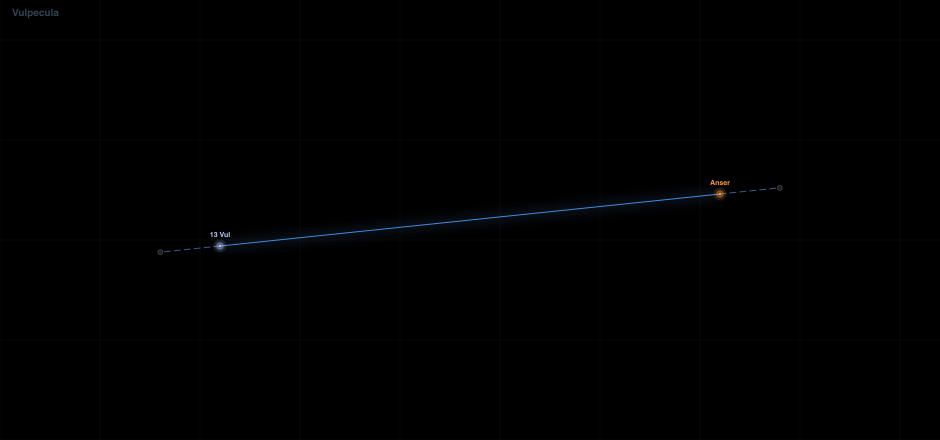
Vulpecula, the Little Fox, was introduced by Hevelius in 1687, originally as 'Vulpecula cum Ansere' (the Fox with the Goose). Its most famous resident is M27, the Dumbbell Nebula, the first planetary nebula ever discovered (by Charles Messier in 1764). In 1967, the first pulsar was discovered in Vulpecula, one of the most important astronomical findings of the 20th century.